


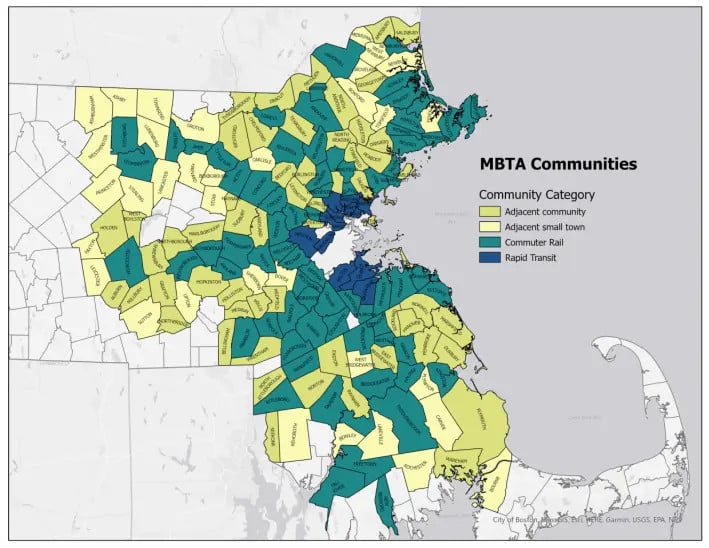
As the calendar turned to 2026, a key deadline tied to one of Massachusetts’ most consequential housing laws quietly passed — and not every community crossed the finish line.
As of December 31, 2025, twelve Massachusetts towns failed to meet zoning compliance requirements under the MBTA Communities Act, according to recent reporting. Per (Boston.com), those municipalities now face possible enforcement actions from the state, including the potential loss of eligibility for certain state grants. The situation highlights an ongoing and increasingly visible tension between local zoning control and statewide efforts to expand housing supply, particularly near public transit.
While the law has been debated since its introduction, this missed deadline marks a turning point. For the first time, noncompliance is no longer theoretical — it may now carry real financial and planning consequences.
What the MBTA Communities Act Requires
The MBTA Communities Act, signed into law as part of broader housing reform, requires cities and towns served by MBTA transit — including subway, commuter rail, and bus routes — to adopt zoning that allows multifamily housing “by right” in at least one transit-adjacent district.
The intent is straightforward: encourage housing density in areas already supported by infrastructure, reduce sprawl, and help address the state’s long-standing housing shortage. Importantly, the law does not require towns to build housing, but it does require them to create zoning conditions that allow it.
Supporters argue that zoning reform is essential to unlocking housing production. Critics, particularly at the local level, say the mandates can feel one-size-fits-all and raise concerns about infrastructure strain, neighborhood character, and local autonomy.
What Happens When Towns Miss the Deadline
For communities that did not meet the December 31 deadline, the stakes are now higher.
Per (Boston.com), noncompliant towns risk losing access to certain state funding streams, including grants tied to infrastructure, housing, and transportation. While the state has some discretion in how aggressively it enforces penalties, the deadline signals that the era of voluntary compliance is ending.
The situation puts pressure on local governments to revisit zoning discussions that, in some cases, have already sparked heated town-meeting debates. For officials, the choice may increasingly come down to accepting zoning changes or foregoing state support — a difficult decision for municipalities that rely on those funds.
Why This Matters for Housing Supply
From a real estate and housing perspective, the implications are significant.
Zoning determines where housing can be built, what type of housing is allowed, and how quickly projects can move forward. By requiring multifamily zoning near transit, the MBTA Communities Act aims to open up new areas for development — particularly in suburbs that have historically limited density.
When towns delay or resist compliance, it slows the potential pipeline of new housing units. Over time, that can contribute to continued inventory shortages, upward pressure on prices, and fewer options for renters and buyers alike.
Conversely, communities that comply — especially those that go beyond minimum requirements — may become focal points for new development, investment, and housing growth in the years ahead.
Implications for Real Estate Professionals
For agents, developers, and investors, MBTA zoning compliance is no longer an abstract policy issue — it’s a practical factor that can influence local market dynamics.
- Developers should pay close attention to which towns are compliant, in progress, or resisting. Zoning certainty can make or break project feasibility.
- Agents may see growing client interest in transit-oriented communities where multifamily housing becomes more common — both for buyers seeking affordability and investors looking for rental opportunities.
- Investors should factor zoning status into long-term valuation and growth projections, particularly in suburban markets near commuter rail lines.
Noncompliant towns may experience slower housing growth, while compliant areas could see increased activity — along with community debate about change.
The Broader Policy Tension
At its core, the MBTA Communities Act represents a broader struggle playing out across Massachusetts: how to balance local control with statewide housing needs.
State leaders argue that the housing crisis requires coordinated action and that zoning reform is a necessary lever. Local officials and residents often counter that planning decisions should remain in local hands, shaped by community context rather than statewide mandates.
The missed deadline underscores that this debate is far from settled. Enforcement actions, appeals, and political pressure are likely to continue into 2026, keeping zoning and housing policy squarely in the spotlight.