



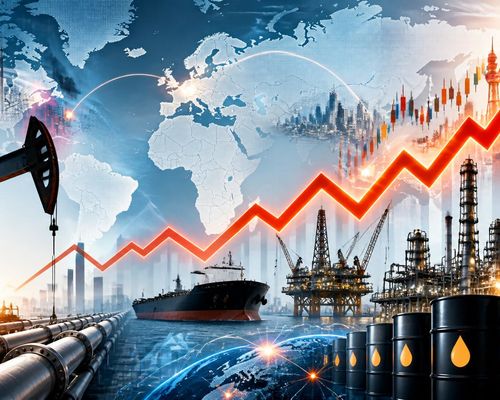
Global financial markets are entering one of their most volatile and fragile periods since the inflation shock of the early 2020s, with surging oil prices, rising bond yields, and escalating geopolitical tensions reshaping the outlook for the global economy.
At the heart of the turmoil is the growing confrontation between Iran and the increasing disruption of energy supplies passing through the Strait of Hormuz, one of the world’s most important oil shipping lanes. Now the fallout is sweeping across virtually every major market from stocks and bonds to currencies and housing and consumer spending.
Over the weekend, renewed attacks in the Gulf region, including reports of a drone strike on a nuclear facility in the United Arab Emirates, intensified fears that the conflict could continue escalating rather than moving toward resolution. At the same time, diplomatic efforts have stalled, with markets reacting negatively to growing uncertainty around negotiations between the United States, Iran, and regional allies.
Energy markets have felt the immediate shock most acutely.
Brent crude oil jumped more than $111 a barrel, and U.S. crude rose near $108 a barrel, extending a rally that has driven oil prices up about 35% since the conflict escalated earlier this year. Oil prices could surge to $150 a barrel if disruptions in the Strait of Hormuz worsen or drag on, raising the risk of a major global inflation shock, analysts are now warning.
And that possibility is starting to change expectations across the world economy.
Fear of Inflation Is Coming Back in Force
For much of late 2025 and early 2026, investors had hoped inflation was finally coming under control. Central banks, including the Federal Reserve, had slowed or paused rate hikes, and markets were increasingly optimistic that rate cuts might come later in the year.
That outlook is now rapidly changing.
Rising energy prices are feeding directly into inflation expectations worldwide. Oil impacts nearly everything, but that outlook is changing rapidly now. Rising energy prices are directly feeding into global inflation expectations. Oil impacts just about every aspect of the economy, from transportation, manufacturing, food production, and consumer goods. As fuel costs rise, businesses pass those costs onto consumers, making inflation broader and more persistent.
Several recent inflation reports have already shown prices accelerating again. Reuters reported that concerns over rising energy costs are now forcing investors to reconsider whether central banks may need to keep interest rates elevated far longer than previously expected.
This has revived fears of a “stagflation” environment—a period where inflation remains high while economic growth slows.
Analysts increasingly warn that the global economy is becoming vulnerable to exactly that combination.
Bond Markets Are Sounding the Alarm
One of the clearest signs of market stress is happening in the bond market.
Government bond yields around the world have surged sharply recently, reflecting investor fears that inflation will remain elevated and central banks may need to maintain restrictive monetary policy for much longer.
The yield on the benchmark U.S. 10-year Treasury note climbed to approximately 4.63%, the highest level since early 2025. Even more alarming for many economists, the 30-year U.S. Treasury yield rose above 5.15%, reaching levels not seen since 2007.
Long-term Treasury yields are critically important because they influence borrowing costs throughout the economy, including:
- Mortgage rates
- Corporate loans
- Auto financing
- Commercial real estate debt
As yields rise, borrowing becomes pricier for households, businesses, and governments alike.
The bond selloff is spreading beyond the United States. Reuters reported that bond markets across Europe and Japan are also experiencing heavy pressure, with Japanese 30-year government bond yields hitting record highs after concerns about new debt issuance and inflation intensified.
This synchronized rise in global borrowing costs is increasing fears that financial conditions are tightening too quickly.
Stock Markets Are Losing Momentum
The surge in oil prices and bond yields is beginning to weigh heavily on stock markets as well.
Asian markets fell sharply Monday morning, with Japan’s Nikkei dropping roughly 1.1%, while broader Asia-Pacific indexes also declined. Wall Street futures turned negative as investors reassessed the outlook for economic growth and corporate profits.
Investors are especially worried about how higher rates and inflation could affect the broader economy.
For months, enthusiasm surrounding artificial intelligence and major technology companies has driven much of the market rally. Firms like Nvidia have become central pillars of market optimism, which helped push U.S. indexes to record highs earlier this year.
But rising bond yields threaten that momentum.
Higher yields reduce the attractiveness of expensive growth stocks by increasing financing costs and lowering the present value of future earnings. Analysts increasingly warn that the AI-driven stock rally could face serious pressure if inflation and rates continue rising.
In other words, the market is beginning to shift from an environment driven by optimism to one increasingly dominated by risk management.
Consumers Around the World Are Feeling the Pressure
The economic consequences now extend beyond financial markets.
Consumers across multiple countries are already experiencing the effects of rising energy costs, particularly through higher gasoline prices. Reuters reported that average U.S. gasoline prices have climbed from around $3 per gallon to over $4.50 per gallon since the conflict intensified earlier this year.
That increase directly impacts household budgets by raising commuting costs, shipping costs, and prices across the broader economy.
At the same time, wages are struggling to keep pace with inflation, creating growing financial pressure for middle- and lower-income households.
This matters because consumer spending remains one of the primary drivers of economic growth. If consumers begin pulling back more aggressively, the economy could slow sharply even while inflation remains elevated.
That is one of the biggest fears now emerging in global markets.
Housing Markets Are Becoming More Vulnerable
One sector particularly exposed to these developments is housing.
Mortgage rates are closely tied to Treasury yields, especially the 10-year Treasury note. As yields rise, mortgage rates typically follow.
That means the recent jump in bond yields is likely to push mortgage rates back toward the mid-to-high 6% range—or potentially higher.
This creates another major affordability problem for homebuyers.
The U.S. housing market was already struggling with the following:
- Elevated home prices
- Weak affordability
- Slow inventory growth
- Fragile buyer confidence
Now, rising energy costs and higher borrowing costs are adding even more pressure.
Construction costs are also increasing because higher oil prices affect the following:
- Transportation
- Building materials
- Manufacturing
- Labor costs
As a result, both the supply side and demand side of housing are squeezing each other simultaneously.
This helps explain why many economists believe the housing market is entering a prolonged stabilization phase rather than a strong recovery.
The Global Economy Is Becoming Increasingly Interconnected
One of the clearest lessons from the current situation is how interconnected modern economies and markets have become.
A geopolitical conflict in the Middle East is now directly influencing:
- U.S. mortgage rates
- Global stock valuations
- Inflation expectations
- Consumer spending
- Bond markets worldwide
The closure or disruption of a single shipping route—the Strait of Hormuz—has become powerful enough to reshape financial conditions across the globe.
This represents a major shift from previous economic cycles, where domestic factors often played a larger role in determining housing and market trends.
Today, global energy markets and geopolitical risks are becoming central economic drivers.