



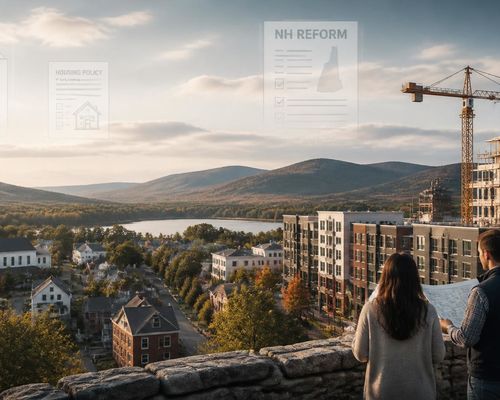
The housing conversation in New Hampshire is moving into a new phase — one that could dramatically change where and how housing is built across the state.
On July 1, 2026, one of the biggest zoning overhauls in recent memory will become official. House Bill 631 (HB 631) would impose a “by right” requirement for multifamily residential development in commercially zoned districts in all municipalities in New Hampshire, subject to certain infrastructure and regulatory conditions.
For developers, investors, planners, and real estate professionals, the implications are substantial.
This is not simply a tweaking of the zoning language. It changes the dynamic between commercial land and residential development across the state — potentially opening up thousands of acres of commercially zoned property to become housing opportunities that previously faced major regulatory hurdles.
At the same time, the law is triggering growing debate over infrastructure capacity, local control, and how quickly municipalities can adapt to a very different development environment.
What HB 631 Actually Does
At its core, HB 631 requires municipalities to permit residential multifamily housing in commercially zoned areas without requiring rezoning approvals or special legislative action, provided projects comply with local site-plan and infrastructure standards.
In practical terms, this means:
- Multifamily housing can now move into many commercial districts more easily
- Mixed-use projects become significantly more feasible
- Existing commercial buildings may be converted into housing with fewer zoning obstacles
- Municipalities cannot categorically prohibit multifamily housing in qualifying commercial zones
The law does not eliminate all local oversight. Municipalities still retain authority over:
- Site-plan review
- Building safety
- Infrastructure capacity
- Environmental and engineering requirements
However, what changes dramatically is the baseline assumption.
Before HB 631, many municipalities either prohibited multifamily residential development in commercial districts outright or required lengthy rezoning processes and discretionary approvals.
After July 1, housing becomes an allowed use by default in many of these areas.
That is a major policy shift.
Why the State Is Moving in This Direction
The push behind HB 631 is rooted in one overriding issue: New Hampshire’s housing shortage.
For years, the state has struggled with:
- Extremely low inventory
- Rising home prices
- Limited workforce housing
- Slow housing production
- Restrictive zoning practices
At the same time, many municipalities already have large areas of commercially zoned land equipped with:
- Road access
- Utilities
- Sewer and water systems
- Proximity to jobs and services
Supporters of HB 631 argue that these areas represent one of the fastest and most efficient opportunities to expand housing supply without pushing development deeper into undeveloped rural land.
Instead of building entirely new infrastructure from scratch, the state is attempting to encourage housing growth in places where infrastructure largely already exists.
From a planning perspective, that is one of the central arguments behind the law.
A Potentially Massive Shift for Development Patterns
The long-term impact of HB 631 could be significant because it changes how developers evaluate commercial property throughout the state.
Commercial parcels that may once have had limited retail or office demand could suddenly become attractive residential or mixed-use redevelopment opportunities.
This is especially relevant in a post-pandemic economy where
- Some office demand has weakened
- Retail patterns continue evolving
- Certain commercial properties remain underutilized
HB 631 effectively creates new flexibility for these sites.
Older strip malls, vacant commercial centers, aging office properties, and underperforming retail corridors may now become candidates for:
- Multifamily housing
- Mixed-use redevelopment
- Workforce housing projects
- Higher-density residential development
For investors, the change could significantly alter land valuation and redevelopment strategy over the next several years.
Why Supporters Say the Law Is Necessary
Supporters of the legislation argue that traditional zoning systems have constrained housing production for too long.
Many believe that local zoning practices — particularly exclusionary or low-density zoning — have made it difficult to build enough housing to meet demand.
HB 631 is viewed by advocates as part of a broader effort to
- Increase housing supply
- Improve affordability
- Encourage smarter land use
- Reduce dependence on greenfield development
- Create more workforce housing near employment centers
There is also a strong economic argument behind the reform.
Employers across New Hampshire continue reporting difficulty attracting and retaining workers because housing remains too expensive or too limited in many regions.
By opening commercial zones to multifamily development, supporters hope the state can create housing in areas that already have economic activity and transportation networks.
Critics Say Law Reduces Local Control
The bill has strong backing from housing advocates and many developers but also significant opposition in some communities.
Critics say the law takes too much power from municipalities and imposes statewide zoning requirements that may not fit local conditions.
One of the largest concerns is the strain on infrastructure.
Even where the law permits commercial land use, local governments worry that existing infrastructure can accommodate the expected increase in residents.
Concerns:
- Water and sewer capacity
- Bottlenecks
- School enrollment effects
- Demand for emergency services
- Utility infrastructure constraints
Some local officials also say commercial districts were not meant for large-scale residential development, and sudden changes could cause planning problems or unintended consequences.
By 2026, this tension between statewide housing needs and local governance has become one of the defining political and planning debates in New Hampshire.
The Real Battlefield Is Infrastructure
One of the biggest developments surrounding HB 631 is that it is part of a larger trend across the state.
👉 Housing debate is more than just zoning.
The discussion is increasingly about infrastructure readiness.
Now many municipalities recognize that the state needs more housing. But they also argue that growth must be consistent with:
- Water availability
- Sewer systems
- Transportation capacity
- Electrical infrastructure
- Public services
This situation means that even with zoning reform, actual housing delivery may still face major practical constraints.
For developers, this creates a more complicated landscape:
- Zoning may become easier
- But infrastructure feasibility may become harder
What This Means for Real Estate Professionals
For real estate professionals, HB 631 could become one of the most important policy shifts in years.
Commercial properties that previously had limited development potential may suddenly attract residential interest. Mixed-use projects may become more financially viable. Land values in certain commercial corridors could shift significantly.
For investors and developers, this law may create:
- New redevelopment opportunities
- Higher-density project potential
- Expanded housing pipeline possibilities
- Increased competition for commercial land
For agents and brokers, understanding how local municipalities plan to interpret and implement HB 631 may become increasingly important when advising clients.