


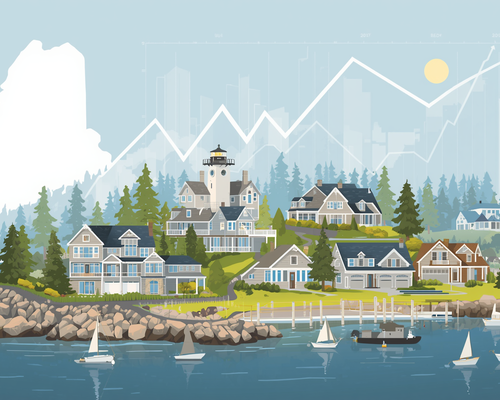
A widening gap is becoming more and more apparent throughout Maine’s housing market in 2026, and it’s most pronounced along the coast.
While much of the state is headed in a more balanced and cautious real estate direction, Maine’s luxury coastal communities are still moving at a very different pace. But as market activity overall is starting to flatten out across the state, waterfront properties in towns like Kennebunkport are still commanding incredibly strong prices at the high end.
Recently, Kennebunkport was named in a national real estate report as having some of the most expensive residential real estate in Maine. This trend has continued to grow over the last several years. The wealthy buyers, many from outside the state, are still looking for coastal Maine properties for second homes, retirement lifestyles, seasonal living, and long-term investment.
The result is a housing market that increasingly feels like two very different worlds.
Coastal Maine Still Attracts High-End Buyers
Luxury coastal real estate in Maine has done quite well despite the slowdown in many other segments of the housing market.
Waterfront homes, ocean-view properties, and high-end seasonal residences continue to attract strong interest from affluent buyers in search of lifestyle-oriented locales. The mix of features in coastal communities is still hard to replicate elsewhere:
- Natural scenery
- Privacy to a degree
- Historical Figure
- Recreation, outdoor
- And around major Northeast population centers
Coastal Maine is still a premium destination market for many higher-income buyers from states such as Massachusetts, Connecticut, and New York, especially for second-home ownership or retirement planning.
That demand has proven remarkably resilient despite high mortgage rates and wider economic uncertainty. In fact, many luxury buyers are less sensitive to interest rates altogether, as purchases are often made with big cash or larger down payments.
Accordingly, the luxury segment has not slowed as much as the overall housing market.
Kennebunkport Follows Trend
Nowhere is this split more visible than in Kennebunkport.
The town has long been known as one of Maine’s premier coastal communities, and it has become increasingly associated with ultra-premium residential pricing. Renovated historic homes, luxury seasonal properties, and waterfront estates still draw buyers willing to pay top dollar for location and lifestyle.
A national report on Kennebunkport's pricing strength illustrates how concentrated high-end demand has become in pockets along the Maine coast.
Some markets around the country are cooling, but the best coastal Maine properties are still holding their value very well.
For many buyers in this segment, buying a home is about more than housing. It’s a lifestyle play, a long-term wealth preservation play, and a chance to gain access to one of the more desirable coastal environments in the Northeast.”
Another Tale from the Interior
The housing picture is quite different in inland and more rural parts of Maine at the same time.
In many of the central and northern communities, the market is much more balanced than the coastal luxury segment. These areas’ homes are:
- More time on the market
- Expect more negotiation activity
- And rising in value more slowly
Inventory has improved a bit in some inland areas, giving buyers a little more choice and a little more leverage than they had during the peak pandemic years.
Now there is still demand statewide, but inland markets are generally much more sensitive to the following:
- Home loan rates
- Concerns on affordability
- Local working conditions
- And budget constraints
That’s widening the gap between the state’s lifestyle-focused luxury markets and its more affordability-focused residential markets.
The Pandemic Shift Never Fully Reversed
Much of this divide traces back to migration patterns that accelerated during the pandemic.
With the rise of remote work and more flexibility for higher-income households, many buyers from larger metros began moving to or investing in Maine. That trend played to the advantage of coastal towns in a big way, providing the mix of natural charm and proximity to Boston and other Northeast cities.
What once seemed temporary has now become more permanent.
Many buyers purchased second homes during the pandemic, and many have held onto their properties, while others continue to look for seasonal or retirement homes in coastal communities. That persistent demand has helped to insulate luxury coastal markets from some of the cooling pressures impacting more general housing conditions.
In many ways the coastal housing market in Maine is no longer operating as simply a local market. Its behavior is increasingly like that of a regional luxury destination market tied to wealth patterns across the Northeast.
What This Means for Real Estate Agents
This growing gap is becoming increasingly relevant to Maine real estate professionals.
The coastal luxury market requires a much different approach than the residential markets inland.
Within luxury coastal communities:
- Today's buyer is more lifestyle-focused than rate-sensitive.
- Marketing quality matters significantly more
- National exposure becomes increasingly important
- The seasons can have a big impact on activity timing
Meanwhile, inland markets remain more heavily shaped by affordability, financing conditions, and local economic factors.
This means statewide averages are becoming less useful for understanding real market conditions. Realtors increasingly need hyper-local expertise because conditions can vary. This means that statewide averages are less useful in understanding real market conditions. As conditions can vary widely by location and price point, real estate agents need to be experts in their very local market more and more. A slowdown in one part of Maine doesn't mean the same thing is happening elsewhere in the state. The same thing is happening elsewhere.
Affordability Pressure Continues Growing
One side effect of the luxury boom on the coast is that it’s driving up the cost of living for locals.
Prices have risen well beyond what many local workers and long-term residents can comfortably afford, as higher-income buyers continue to compete for a limited housing supply in desirable coastal towns. This has created further discussion about:
- Workforce housing shortages
- Seasonal home ownership
- Short-term rentals
- And year-round housing availability
Coastal Maine communities are still grappling with how to balance economic growth and investment related to tourism with access for local residents.
That tension is likely to remain one of the defining housing issues for the state going forward.