



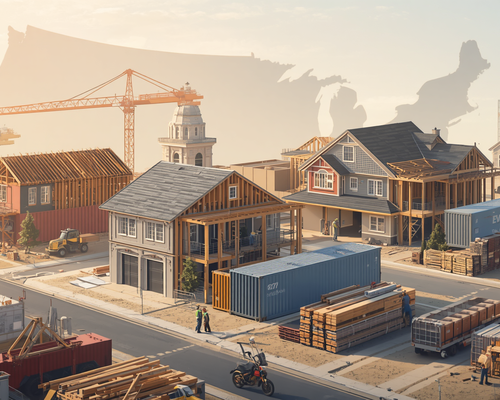
The U.S. housing market faces yet another obstacle as builders, buyers, and policymakers grapple with affordability issues that have plagued much of 2026. President Donald Trump signed a proclamation this week that modifies tariffs on imported steel, aluminum, and copper products—a move that could have lasting impacts on construction costs, home prices, and future housing supply.
The White House said the move was part of an effort to boost domestic manufacturing and spur the use of metals made in the United States, but economists and housing industry leaders are closely watching the potential impact of the changes on an already tight housing market.
It’s the timing. Mortgage rates are still high, affordability is near historic lows, and homebuilders have already been slowing new construction activity in many parts of the country. Under those circumstances, any rise in the cost of materials could pose further problems for an industry already operating under a lot of pressure.
A New Chapter for the Administration’s Metals Trade Policy
The proclamation, signed June 1, updates the administration’s Section 232 national security tariff framework for imports of steel, aluminum, and copper. The latest changes reshape the tariff system’s approach to certain derivative products and introduce new incentives for producers that use significant amounts of U.S.-made metal in their goods.
The new rules would allow products with at least 85% of their steel, aluminum, or copper content sourced in the U.S. by weight to be eligible for a lower tariff of 10%. Some imported industrial and agricultural equipment, including HVAC systems, bulldozers, forklifts, combines, and harvesters, will see tariffs cut to 15% from 25%. The changes are expected to be in place through the end of 2027.
Administration officials said it was meant to boost domestic production of the metals while minimizing unintended costs for industries that rely heavily on manufactured equipment. Proponents say that encouraging greater use of American-made metals could spur investment in domestic industrial capacity and reduce reliance on foreign supply chains.
But many economists point out that even if tariffs are reduced on some finished goods, the overall tariff structure continues to increase costs throughout the manufacturing and construction supply chain.
Why Builders Are Watching Closely
For the housing industry, the importance of steel, aluminum, and copper is far more than headlines about trade policy.
These materials are used in almost every stage in residential construction.
Structural framing and fasteners, roofing systems, appliances, and reinforcements are all made of steel. Aluminum is found in windows, doors, gutters, siding components, and HVAC systems. Copper is still needed for electrical wiring, plumbing, and mechanical infrastructure. So any shift in the price of these materials can have a domino effect on the entire homebuilding process.
Builders have been dealing with volatile material costs for much of the last several years. Construction costs have already risen well above pre-pandemic levels due to lumber volatility, supply chain disruptions, labor shortages, increased insurance, and the cost of financing.
Now, many in the industry are concerned that additional cost pressures related to trade could further complicate efforts to build affordable homes.
The administration’s latest adjustments to tariffs on certain categories of equipment do little to ease builders’ fears that broader tariff schemes on steel, aluminum, and copper could still drive up the price of construction inputs overall.
Housing Starts Already Slowing
The tariff announcement comes as construction activity is already showing signs of weakness.
Latest housing numbers show a sharp drop in single-family housing starts and a moderation in permits for future construction. Builders continue to cite affordability, high mortgage rates, and uncertainty about future demand as the primary reasons they have not been able to ramp up production. There are signs of improvement in some regional markets, but recent industry surveys show builder confidence remains low.
The problem for economists is that higher material costs could put off additions, especially projects for entry-level and affordable buyers.
In many markets, builders are already offering mortgage-rate buydowns, closing-cost assistance, and price incentives to keep sales moving. Profit margins have been compressed as companies try to balance rising expenses with consumers' limited ability to absorb higher prices.
Builders might push back on projects, cut production, or move to more expensive homes where buyers can handle higher prices better if construction costs go up again.
The Market’s Biggest Challenge Is Still Affordability
Affordability is still the core issue in the housing market.
Mortgage rates have been above 6% for most of 2026, and home prices are high in much of the country. Meanwhile, the cost of insurance premiums, property taxes, and maintenance has continued to rise.
The primary obstacle to market activity, housing economists now say, is affordability, not a lack of buyer interest. There is still demand, but the monthly cost of owning today is simply unaffordable for millions of households.
That is why construction costs are so important.
In a case of higher costs, those costs tend to pass through to home prices, either directly, in terms of higher asking prices, or indirectly, in terms of lower supply. In either case, it’s more difficult to improve affordability.
This is one of the reasons why policymakers have increasingly focused on supply-side housing reforms. Congress just advanced the 21st Century ROAD to Housing Act. The legislation seeks to increase housing production and remove barriers to development. But those efforts could become more difficult if material costs go up.
The industry is getting mixed messages
One of the more unusual aspects of the latest tariff changes is that they include both cost-reducing and cost-increasing elements.
Contractors, agricultural operators, and some construction-related businesses may benefit from lower tariff rates on some equipment categories. Manufacturers that use significant amounts of American-produced metals may also be eligible for reduced tariff treatment.
Meanwhile, the broader trade environment remains uncertain. Tariffs, trade negotiations, and supply chain policies can change quickly, and builders and manufacturers still find themselves operating within this landscape.
Uncertainty itself can be a cost for developers planning projects that can take years to complete. Companies are very reluctant to make investment decisions if they don’t know what prices are going to be in the future.
That uncertainty has become an increasingly important factor across the housing industry in 2026.
A Market Already Under Pressure
The latest tariff move comes as the housing market is already battling a number of competing forces.
Mortgage rates are still high. Home sales are still a little soft. Builders are still tweaking production volumes. Buyers are getting more aware of their payment. And affordability is one of the biggest economic issues for American families.
Against that background, it is disproportionately important that any development impacts construction costs.
The long-term effect of the tariff changes will depend on the response of manufacturers, suppliers, and builders in the months ahead. Some companies may be able to change their sourcing strategies or benefit from lower rates for products with large amounts of U.S.-made metal. The rest are left with increased costs that eventually filter down the housing supply chain.
Discussion
Thoughts from readers and local market watchers.