



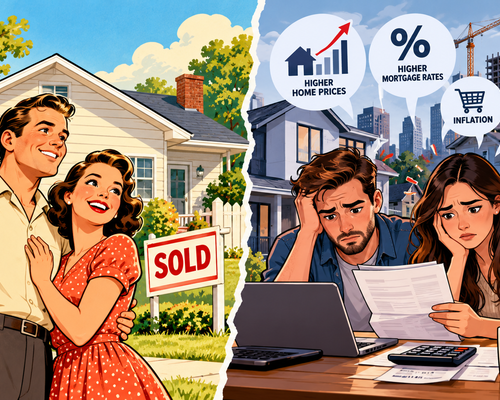
For many Americans, buying a home used to be a milestone that a middle-income household could realistically work toward. Today, that same goal can feel increasingly out of reach, even for people with steady jobs and years of savings. The difference is not simply that mortgage rates are high. It is that home prices have climbed far beyond what typical household incomes can comfortably support.
A recent analysis by The Washington Post highlights just how much affordability has changed. Among the 100 largest U.S. housing markets, only three have home prices at or below three times median household income. In 1990, homes were considerably more affordable relative to local incomes across a much broader range of markets. Meanwhile, mortgage rates have climbed to around 7.4%, adding another obstacle for prospective buyers. (The Washington Post)
The result is a housing market where even households that earn reasonable incomes can struggle to qualify for a home without stretching their finances.
Home Prices Have Outpaced Paychecks
The central challenge is the growing gap between what homes cost and what households earn.
When home prices rise faster than incomes, buyers must save larger down payments, borrow more money or settle for smaller homes and less expensive locations. Higher prices also increase the amount of interest paid over the life of a mortgage.
For previous generations, buying a home was not necessarily easy, and affordability varied significantly by location. However, in many markets, home prices were more closely aligned with household earnings, making it more feasible for buyers to build savings and qualify for financing.
Today, that relationship has become much more difficult. Years of price appreciation, limited housing construction in some high-demand areas and the rising cost of building have all contributed to the affordability gap.
Higher Mortgage Rates Make the Problem Worse
Mortgage rates have added another layer of pressure.
When rates rise, buyers pay more each month to finance the same home. A household that could afford a particular property at a lower rate may no longer qualify at today's borrowing costs, even if its income has not changed.
Consider a $350,000 mortgage. At a 3% interest rate, the monthly principal-and-interest payment is approximately $1,476. At 7.4%, that payment rises to about $2,421. That is a difference of roughly $945 per month, before property taxes, homeowners insurance or maintenance.
This is why today's affordability challenge feels different from simply dealing with higher interest rates. Buyers are often paying more for the property itself while also facing a higher cost to finance it.
Limited Supply Keeps Pressure on Buyers
The shortage of affordable homes is another important part of the problem.
In many communities, construction has not kept pace with demand for smaller, entry-level properties. Builders also face expensive land, labor shortages, material costs and local restrictions that can make lower-priced projects difficult to deliver profitably.
Existing homeowners can contribute to the supply problem as well. Those who locked in mortgage rates well below current levels often have little incentive to sell and take out a more expensive loan on their next home.
That reluctance can limit the number of properties available to first-time buyers, particularly in markets where demand remains strong.
Younger Buyers Face a Different Starting Point
For younger Americans, the challenge often begins before they even apply for a mortgage.
Higher rents and everyday expenses can make it harder to save for a down payment. Meanwhile, rising home prices mean that the amount needed to purchase a property may increase faster than savings accumulate.
Some buyers respond by moving farther from major job centers, purchasing smaller homes, sharing housing costs or delaying homeownership altogether. Others remain renters longer than they originally planned.
Parents who bought homes decades ago may remember stretching their budgets or saving for years to make a purchase. But younger buyers are navigating a market in which the relationship between earnings, home prices and borrowing costs has changed substantially.
What Could Make Homeownership More Affordable?
A meaningful improvement will likely require more than a decline in mortgage rates alone.
Lower borrowing costs would help reduce monthly payments, but the longer-term solution also depends on expanding the supply of homes that middle-income households can afford. That includes smaller starter homes, townhouses, manufactured housing and apartments that allow households to save before purchasing.
Local zoning changes, more efficient construction methods and policies that make entry-level development financially viable could also help over time.
For now, the affordability gap remains one of the housing market's biggest structural challenges. Buyers may find more listings and greater negotiating power in some markets, but those advantages do not necessarily make a home affordable when prices and financing costs remain high.
The generational divide in homeownership is ultimately about purchasing power. Until incomes, home prices and mortgage costs move into a more sustainable relationship, buying a home will remain a much harder financial milestone for many younger Americans than it was for their parents.
Discussion
Thoughts from readers and local market watchers.