



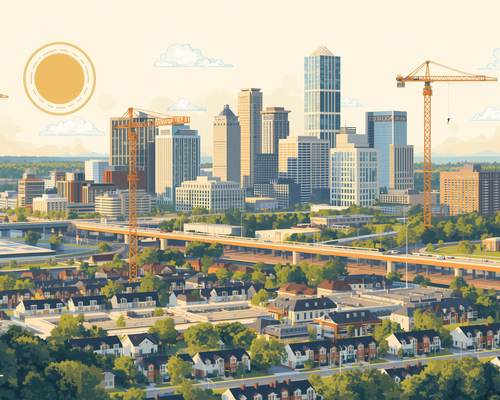
Charlotte is on the verge of a milestone that would have seemed almost impossible just a few decades ago.
The city is now hurtling toward 1 million residents, cementing its status as one of the nation’s fastest-growing big cities and strengthening North Carolina’s rise as one of the country’s most powerful growth engines. But as Charlotte reaches that milestone, the city is also wrestling with an increasing question: How much growth can it swallow before affordability, infrastructure, and quality-of-life issues begin to outweigh the benefits?
New Census estimates show Charlotte added more than 20,700 residents from 2024 to 2025 alone, the largest numerical population gain of any city in the United States over that span of time. The city’s population now stands at roughly 964,784 residents, putting it within spitting distance of the one-million mark.
The increase is the result of years of migration, corporate expansion, and economic momentum that changed Charlotte from a regional banking center to one of the most powerful metropolitan areas in the Southeast.
Why So Many People Keep Moving to Charlotte
For years, Charlotte has had a sweet combination of things that made it very attractive to businesses and new residents.
Charlotte had a lower cost of living, better job opportunities, and a more growing urban core than bigger metros like New York, Washington D.C., Atlanta, and parts of California. The city’s role as the second largest banking center in the country helped fuel professional job gains, while broader gains across healthcare, technology, logistics, and manufacturing added more economic momentum.
Many of those migration trends were sped up by the pandemic. Remote work enabled more households to migrate away from higher-cost states and still work in major metropolitan markets. North Carolina was one of the greatest recipients of that change, and Charlotte was one of the early winners.
The result has been a population boom the likes of which the city has never seen.
Growth in the region has spread well beyond the Charlotte urban core, fueling development deeper into surrounding communities in Mecklenburg County and neighboring counties in North and South Carolina.
Housing market pressure
Growth has powered economic expansion, but it has also transformed Charlotte’s housing market in big ways.
Affordability is one of the biggest concerns today.
Home values have risen sharply over the last several years, and the income needed to comfortably afford a home in Charlotte has climbed substantially since 2020. As demand surged and inventory struggled to keep pace, housing costs increased much faster than many local incomes.
But longtime residents say the city increasingly feels like a different city than the Charlotte they once knew. Prices have been rising in neighborhoods that were once affordable, and new construction continues to push outward into suburban and exurban communities.
The city's affordability remains one of its biggest long-term challenges, although inventory conditions have improved somewhat from the peak pandemic housing frenzy.
Developers continue to build apartments, townhomes, and master-planned communities at a rapid pace, but population growth has been strong enough that housing demand continues to pressure supply.
Traffic, Infrastructure, and Growth Fatigue
Housing is only part of the picture.
Charlotte is growing, and infrastructure is struggling to keep up with the growth.
One of the most common frustrations among residents has become traffic congestion. Major commuter corridors continue to see heavier traffic volumes. Discussions about transportation funding and future transit expansion continue.
Meanwhile, growth is straining schools, utilities, public services, and local government planning efforts.
For many who moved to Charlotte looking for a more affordable and manageable alternative to larger cities, they now find themselves dealing with some of the same problems they were trying to avoid: rising costs, increasing congestion, and constant development.
That tension is becoming a defining part of Charlotte’s identity.
The City Keeps Growing — And It’s Not Stopping
Even with those challenges, few observers see Charlotte stalling out any time soon.
The economic fundamentals are strong.
It continues to be a magnet for major employers, corporate relocations, and investment. Population projections indicate the Charlotte metro area’s population will double or even triple over the next several decades, from about 3 million residents today to more than 4.5 million by 2050.
Charlotte Douglas International Airport is also undergoing significant expansion projects to prepare for future growth, including runway improvements, terminal upgrades, and long-term infrastructure investments.
These developments speak to a larger truth: Charlotte is no longer an emerging market. It is increasingly assuming the function of a large national city.
Urban Planning’s Moment of Truth
As Charlotte approaches a million residents, the conversation about growth is becoming more and more pressing.
How to keep growing without losing affordability and quality of life is a question city leaders, developers, housing advocates, and residents are all struggling with.
This includes discussion of:
- Dichte der Wohnbebauung
- Transit investments
- Zoning policy
- Infrastructure dollars
- Development of Affordable Housing
- Long-term land planning
The next decade in the city may be less about whether growth continues and more about how well it is managed.
Why It Matters to Real Estate
Charlotte’s population boom is a double-edged sword for real estate pros.
One of the strongest fundamentals in the market is long-term housing demand, which is still supported by job growth and migration trends. Population growth drives demand for housing, multifamily development, retail expansion, and commercial investment.
But affordability concerns that are rising and constraints of infrastructure are variables that are increasingly important.
Growth alone doesn't drive the market anymore. It is increasingly being shaped by the city’s ability to support that growth sustainably.

Discussion
Thoughts from readers and local market watchers.