



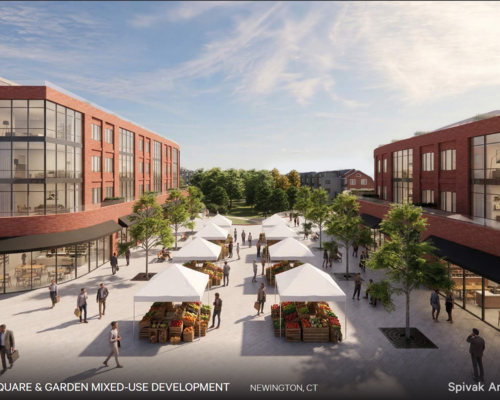
One of the most significant development proposals currently emerging in Connecticut is taking shape in the heart of Newington, where a large mixed-use project could dramatically reshape the town center and reflect the broader direction of suburban redevelopment happening across the state.
Per CT Insider, New York-based Stillman Development has proposed a major project known as “Town Square and Garden” at 1170 Main Street in Newington. The proposal would bring 244 residential apartments, nearly 48,000 square feet of retail and commercial space, underground parking, and multiple public gathering areas into one integrated development.
If approved, the project would become one of the most ambitious town-center redevelopment efforts currently underway in Connecticut.
A Shift Away From Traditional Suburban Development
The proposal represents a major departure from the kind of suburban commercial development that dominated Connecticut for decades.
Instead of standalone retail buildings surrounded by large parking lots, projects like Town Square and Garden are designed around a more modern planning philosophy focused on:
- Walkability
- Mixed-use living
- Community gathering space
- Higher residential density
- Pedestrian-friendly design
Developers and planners increasingly view these types of projects as critical to revitalizing suburban downtowns that are competing with changing consumer habits, remote work trends, and evolving housing demand.
The Newington proposal reflects a growing statewide movement toward creating environments where residents can live, shop, dine, and socialize within the same district.
Inside the “Town Square and Garden” Proposal
According to plans filed with the town, the development would combine residential, commercial, and public-use components into a single large-scale project designed to function as a true mixed-use district rather than a conventional apartment complex.
The residential portion would include 244 apartments spread across multiple buildings. The retail component would feature restaurants, shops, and commercial space intended to create year-round activity within the town center.
One of the most notable features of the proposal is its emphasis on placemaking. The design includes outdoor gathering areas, open public space, landscaping, and pedestrian-oriented features intended to create a more active and connected downtown environment.
Underground parking is also part of the plan, allowing more surface space to be dedicated to walkability and public use rather than large parking fields.
This approach mirrors redevelopment strategies increasingly being used in higher-growth suburban markets across the Northeast.
Why Town Centers Are Becoming Development Targets
Projects like this are becoming more common because Connecticut towns are increasingly recognizing the economic value of revitalized downtown districts.
Town centers offer several advantages for developers:
- Existing infrastructure
- Established road networks
- Nearby retail and services
- Community identity and visibility
- Potential for higher-density zoning support
As suburban retail patterns evolve, many municipalities are actively looking for ways to transform aging commercial corridors into more dynamic mixed-use environments.
The goal is often twofold:
- Increase housing supply
- Strengthen economic activity in the downtown core
In Newington’s case, the proposal could bring hundreds of new residents directly into the town center, potentially increasing foot traffic for local businesses and supporting additional investment nearby.
Connecticut’s Housing Demand Continues Driving Development
The timing of the proposal also reflects the broader housing challenges facing Connecticut.
The state continues to experience:
- Tight housing inventory
- Rising home prices
- Strong rental demand
- Limited multifamily supply in many suburban markets
As affordability pressures grow, towns are increasingly being pushed to allow more residential development, particularly in areas already connected to commercial infrastructure.
Mixed-use projects are often viewed as a politically and economically practical solution because they add housing while also generating retail activity and expanding the local tax base.
For developers, this type of project also aligns with changing lifestyle preferences. Many renters and younger buyers increasingly prioritize walkable communities and access to amenities over traditional suburban layouts.
A Broader Statewide Trend Toward Density and Redevelopment
The Newington proposal is not happening in isolation.
Across Connecticut, municipalities are seeing growing pressure to:
- Approve higher-density housing
- Encourage multifamily development
- Support adaptive reuse projects
- Expand transit-oriented growth
This trend has accelerated alongside statewide housing reform discussions and growing concern over affordability and housing shortages.
Communities like Stamford, Norwalk, West Hartford, and New Haven have already embraced large mixed-use and multifamily projects in recent years. Increasingly, suburban towns are beginning to move in the same direction.
Projects once considered too dense or urban for suburban communities are now becoming more common as towns attempt to balance growth, housing demand, and economic development.
Potential Economic Impact for Newington
If approved, Town Square and Garden could significantly affect Newington’s local economy and real estate market.
The addition of hundreds of new residential units could:
- Increase consumer activity for nearby businesses
- Strengthen demand for restaurants and retail
- Expand the town’s tax base
- Encourage additional redevelopment nearby
Large mixed-use projects often create ripple effects that extend beyond the initial development itself. Adjacent properties may become more attractive for redevelopment, while surrounding residential values can benefit from improved amenities and increased investment activity.
The project could also position Newington more competitively among central Connecticut communities seeking to attract younger residents and long-term economic growth.
What This Means for Real Estate Professionals
For real estate agents, investors, and developers, the Newington proposal highlights where Connecticut’s market is increasingly heading.
The strongest development opportunities are no longer limited to major urban centers. Suburban downtown districts are becoming some of the most important redevelopment targets in the state.
Projects centered around walkability, mixed-use living, and higher-density housing are attracting growing support because they align with both market demand and broader state housing priorities.
At the same time, town-center redevelopment is becoming a major strategy for municipalities trying to modernize commercial corridors and increase housing supply without sprawling outward into undeveloped land.
The Bigger Picture: Connecticut’s Suburbs Are Evolving
Perhaps the most important takeaway from the Newington proposal is what it says about the future of suburban Connecticut.
For decades, many towns prioritized lower-density, auto-oriented development patterns. But rising housing demand, changing consumer behavior, and economic pressures are forcing communities to rethink how land is used.
The result is a growing shift toward:
- Mixed-use redevelopment
- Multifamily housing
- Walkable downtown districts
- Community-centered design
Projects like Town Square and Garden are becoming symbols of this transition.