



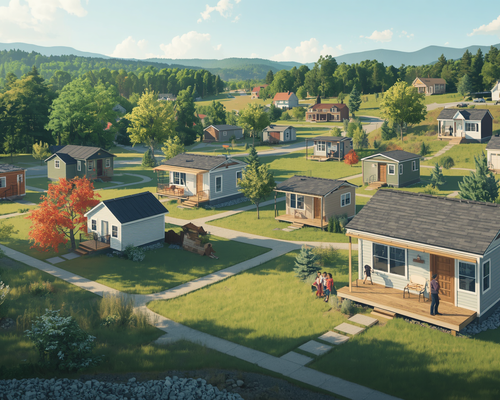
As New Hampshire continues searching for solutions to its housing shortage, one of the most talked-about proposals in Concord right now is not focused on large apartment complexes or major subdivisions.
Instead, it’s focused on something much smaller.
House Bill 1681 (HB 1681), one of the state’s most closely watched housing bills in 2026, is rapidly advancing through the Legislature and could fundamentally change how New Hampshire defines and regulates alternative housing. The proposal would formally recognize tiny homes, tiny homes on wheels, and yurts under state law while establishing statewide standards for how they can be approved and used.
For supporters, the bill represents a practical response to rising housing costs and shrinking affordability. For critics, it raises questions about zoning, infrastructure, and long-term community planning.
But regardless of where the debate lands, one thing is becoming increasingly clear:
👉 Alternative housing is no longer a fringe concept in New Hampshire — it is rapidly entering the mainstream housing conversation.
What HB 1681 Would Actually Do
At its core, HB 1681 attempts to create clearer statewide rules for what the legislation calls “innovative housing.”
The bill specifically addresses:
- Tiny homes
- Tiny homes on wheels
- Yurts and similar alternative residential structures
Under the proposal, these housing types could legally be used as permanent residences if they meet established standards. The bill also creates a formal framework for inspection, safety compliance, and municipal oversight.
One of the key provisions is the size limitation. Structures classified under the law would generally be capped at approximately 600 square feet, reinforcing the intent that these remain compact housing options rather than replacements for traditional full-size homes.
Importantly, the legislation does not completely override local control. Municipalities would still maintain authority over zoning and land use decisions, meaning towns could still regulate where and how these structures are permitted. However, the bill would establish statewide consistency around how these homes are recognized and inspected.
That consistency is a major reason the proposal has gained traction.
Why This Bill Is Gaining So Much Attention
The timing of HB 1681 is not accidental.
As of spring 2026, New Hampshire’s median home prices remain above $500,000 in many parts of the state, especially in Southern New Hampshire and the Seacoast region. Entry-level inventory remains extremely limited, and affordability pressures continue to intensify for first-time buyers, retirees, and middle-income households.
At the same time, the state continues to face:
- Limited buildable land
- High construction costs
- Labor shortages
- Infrastructure constraints
- Ongoing zoning battles
Traditional housing development alone has not been able to close the supply gap fast enough.
That reality has pushed lawmakers, housing advocates, and developers to explore alternatives that were once considered niche or unconventional.
Tiny homes have increasingly become part of that discussion because they offer several potential advantages:
- Lower construction costs
- Smaller land requirements
- Reduced utility usage
- Faster build timelines
- More attainable price points
For many supporters of HB 1681, the bill is less about novelty and more about flexibility.
The Senate’s Recent Action Signals Growing Momentum
One reason this proposal has become one of the biggest housing stories in New Hampshire right now is the speed at which it has moved in recent weeks.
As of May 7, 2026, the Senate advanced the legislation with amendments, signaling significant legislative interest in expanding alternative housing pathways statewide.
That momentum matters because housing bills often stall once concerns emerge around zoning or local control. The fact that HB 1681 continues advancing suggests there is growing bipartisan recognition that New Hampshire may need a wider variety of housing types to address affordability challenges.
The discussion also reflects a broader national trend. Across the country, states and municipalities are reevaluating housing regulations to accommodate:
- Tiny homes
- Accessory dwelling units (ADUs)
- Manufactured housing
- Modular construction
- Other lower-cost housing models
New Hampshire now appears to be moving more aggressively into that space.
A Major Shift in the Entry-Level Housing Conversation
For real estate professionals, HB 1681 has the potential to become one of the most significant shifts in entry-level housing policy the state has seen in years.
Traditionally, first-time homeownership in New Hampshire has centered around:
- Starter single-family homes
- Condominiums
- Smaller suburban properties
But in many areas, those options have become increasingly inaccessible due to pricing.
Tiny homes and other innovative housing models introduce a different framework entirely. Instead of trying to reduce the cost of traditional homes, the focus shifts toward creating entirely new ownership categories with lower overall costs.
That distinction is important.
If legalized and standardized statewide, these housing types could create:
- New ownership opportunities for younger buyers
- Downsizing options for retirees
- Workforce housing alternatives
- Supplemental income opportunities on existing properties
In some cases, they may also intersect with accessory dwelling unit policies already expanding across New Hampshire.
The Challenges and Questions Still Ahead
While support for innovative housing is growing, the proposal is not without controversy or uncertainty.
Several major questions remain unresolved.
One concern is infrastructure. Even small homes still require:
- Water access
- Sewer or septic systems
- Electrical service
- Road access
- Emergency services compatibility
In rural areas, especially, infrastructure limitations could still prevent widespread adoption.
Another issue is local zoning resistance. Although municipalities retain oversight, some communities may resist broader acceptance of alternative housing types out of concern for:
- Density
- Neighborhood character
- Property values
- Enforcement and code compliance
There are also financing and appraisal questions that remain largely unresolved. Because tiny homes often fall outside traditional residential standards, lending and valuation processes may not be straightforward.
This means that while the bill may legalize and standardize these structures, the broader housing ecosystem — including lenders, insurers, municipalities, and assessors — may still need time to adapt.
What This Means for Developers and Investors
For developers and investors, HB 1681 could open entirely new market segments.
If alternative housing becomes easier to permit and standardize, opportunities may emerge for:
- Tiny home communities
- Hybrid residential developments
- Short-term rental models
- Workforce housing projects
- Retirement-focused communities
At the same time, lower-cost housing models could create more competition within certain segments of the traditional entry-level market.
This is why many in the industry are watching the bill closely. Its impact may extend far beyond individual tiny homes.
A Reflection of a Bigger Housing Shift
More than anything, HB 1681 reflects a larger transformation happening in New Hampshire housing policy.
For years, the housing conversation focused almost entirely on:
- Building more traditional homes
- Expanding subdivisions
- Increasing multifamily development
Now, the conversation is broadening.
Lawmakers are increasingly recognizing that solving the housing shortage may require:
- More housing types
- More flexible zoning
- Smaller footprints
- Alternative ownership models
- Faster, lower-cost construction methods
HB 1681 sits directly in the middle of that evolving conversation.