



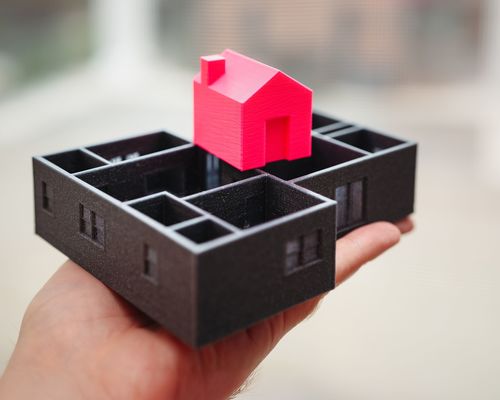
Maine is taking an unusual approach to its housing shortage as the University of Maine moves forward with plans to build nine 3D-printed homes in the Greater Bangor area for people experiencing or at risk of homelessness.
The project received a major boost this week after UMaine's Advanced Structures and Composites Center secured $4 million in federal funding to design and produce the homes in partnership with Penquis. The development will be the first housing project in Maine built using wood waste from the state's sawmills.
Each home is expected to be approximately 600 square feet, with one bedroom, one bathroom, and a combined kitchen and living area. The homes will be designed specifically to withstand Maine's harsh winters, building on the university's BioHome3D prototype that has been operating on the Orono campus since 2022.
The technology behind the project is what makes the development particularly interesting for Maine's real estate industry.
UMaine's BioHome3D system uses a combination of recycled materials and wood residuals from Maine sawmills to manufacture components of the homes. Researchers say using locally available wood waste could help lower material costs while also creating another use for products generated by Maine's forest-products industry.
The university also believes the technology could help address one of the biggest challenges facing housing construction: labor.
Traditional homebuilding depends heavily on skilled workers, and Maine continues to face shortages across the construction trades. By using automated manufacturing and 3D-printing technology, researchers hope to reduce the amount of labor required to produce each home and eventually make construction faster and more affordable.
The nine-home neighborhood is being developed in partnership with Penquis, which has already secured approximately $3 million in additional funding from a combination of federal, local and private sources. The exact location has not yet been finalized, although North Brewer had previously been considered as a potential site.
For Maine, the project comes at a time when the state continues struggling with a shortage of affordable rental housing. Penquis estimates that Maine is short approximately 20,000 to 25,000 affordable rental units, creating pressure on communities to find alternatives to traditional construction.
That is where the significance of the Bangor-area project extends beyond the nine homes themselves.
If UMaine can demonstrate that 3D-printed homes can be produced efficiently, meet building requirements, withstand Maine's climate and remain affordable, the technology could eventually be expanded to other communities facing similar housing shortages.
Researchers are not treating the project as a one-time demonstration. Plans call for the homes to be produced in groups of three, allowing the team to learn from each stage and make improvements before moving on to the next homes.
The project also represents a potential new direction for Maine's construction industry.
The state's housing shortage has traditionally been approached through zoning reform, conventional construction, affordable housing subsidies, accessory dwelling units and adaptive reuse. Those strategies will continue to be important, but developers are increasingly looking at technology and alternative construction methods as another way to reduce costs and speed up production.
For Realtors and housing professionals, the development is worth watching because construction costs and labor availability remain two of the biggest barriers to increasing Maine's housing supply.
A 3D-printed house is not going to solve Maine's housing shortage by itself. Nine homes represent only a tiny fraction of the state's overall need. But the project could provide something just as important: a real-world test of whether new construction technology can make affordable housing easier and less expensive to build.
If the Bangor-area neighborhood performs as expected, Maine could eventually have a new tool for addressing housing affordability—one that uses local materials, automated manufacturing and technology developed right here in the state.
For now, the focus is on getting the first nine homes built. But the bigger question is what happens afterward.
If BioHome3D proves it can deliver durable, energy-efficient homes at a competitive cost, this small Bangor-area neighborhood could become the starting point for a much larger change in how Maine builds housing.
Discussion
Thoughts from readers and local market watchers.