



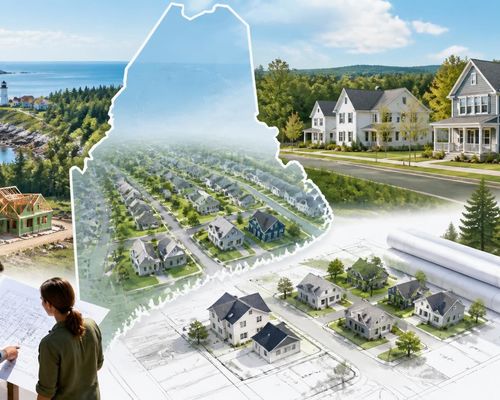
As Maine continues to seek solutions to its housing crunch, a proposal that has quietly gained momentum is getting another look: pre-approved housing plans.
A new national report, released this month, highlights how these programs can reduce construction delays, lower development costs, and help communities add housing more efficiently—all without major changes to local zoning laws or large public spending initiatives.
The discussion matters to real estate professionals, developers, and municipalities in Maine because the state still lacks sufficient housing to satisfy demand. While zoning reform, affordability programs, and infrastructure issues have dominated the housing discussion in recent years, preapproved plans are emerging as a smaller but potentially practical tool that could help reduce some of the friction hampering new construction.
What Are Preapproved House Plans?
Preapproved housing plans are building plans and designs that have been reviewed and approved by a municipality prior to construction. Local governments allow for the reuse of these plans, rather than forcing each developer or homeowner to go through the design and permitting process anew.
That means builders often can get through permitting much quicker because the city has already checked that the plans meet local building and zoning requirements.
The idea is simple, but housing researchers say the effect can be significant.
Preapproved plans can potentially reduce development costs by about 1–2%, or $5,000 to $10,000 per single-family home, according to a report from the Pew Charitable Trusts released in May 2026. Researchers also found that shorter permitting timelines can greatly reduce project delays that often add major costs to housing construction.
In housing development, time is money. “The longer it takes to get approvals, the more the carrying costs, financing pressure, and overall project costs increase month by month."
Why Maine Is Paying Attention
Last year, lawmakers passed a bill that would require the Maine Office of Community Affairs to study the feasibility of creating a statewide inventory of pre-approved building plans. The goal was to make it easier and more accessible for municipalities and smaller developers to construct housing.
Last year, lawmakers passed a bill that would require the Maine Office of Community Affairs to study the feasibility of creating a statewide inventory of pre-approved building plans. The goal was to make it easier and more accessible for municipalities and smaller developers to construct housing. But the effort was ultimately not funded, leaving the future of a statewide program uncertain.
Already some Maine cities are testing their own versions of the idea, even without a statewide rollout.
This has been one of the most visible examples of Bangor.
The city is rolling out a series of free, preapproved housing plans to help accelerate development and reduce design costs for builders. Plans range from accessory dwelling units to multi-family housing designed to fit into existing neighborhoods.
City officials had hoped the program would break down some of the barriers that have prevented new housing, especially after local housing studies showed significant shortages in affordable units.
The Challenge: Awareness & Adoption
But so far, adoption has been slower than expected.
As of early 2026, despite the city spending more than $180,000 designing preapproved plans, no developer had formally used Bangor’s preapproved plans to complete a housing project.
Local officials say a simple lack of awareness may be one reason. Most residents and developers may not know about plans or how much time and money they could save.
At the same time, pre-approved plans are not a complete solution by themselves. While designs are approved, developers still face many of the same challenges that affect housing construction throughout Maine: high material costs, financing challenges, a labor shortage, and infrastructure constraints.
But supporters say the plans can help ease at least one part of the process.
Why the idea is promising, say researchers
The Pew report found that cities that have effectively used preapproved plans have been able to add housing more efficiently, especially smaller infill projects and missing-middle housing like duplexes and small apartment buildings.
The results have been so significant for some communities outside of Maine that they have gained national attention.
Researchers noted that:
- South Bend, Ind., constructed more than 200 housing units in three years with preapproved plans
- Other cities had faster permitting and lower architectural costs
- Smaller developers gained from not having to pay for expensive custom design work
Housing advocates say these types of programs can be especially helpful for:
- larger cities
- Tiny communities
- New developers
- Homeowners constructing accessory dwelling units
The plans are already standardized and reviewed, and as such, they can also take away administrative workload from municipal staff.
The Bigger Housing Problem Still Exists
Even proponents concede that preapproved plans aren’t a “silver bullet” for Maine’s housing shortage.
But the state still has much bigger structural challenges to overcome, such as limited inventory, rising construction costs, infrastructure constraints, and affordability gaps that continue to price many buyers and renters out of the market.
Recent housing studies estimate tens of thousands of more housing units are needed statewide in Maine over the next few years to meet demand. Only Bangor has identified the need for hundreds of new affordable units for lower-income residents.
That means that just speeding up permitting is not going to solve the problem.
But housing experts are increasingly saying the shortage will require a lot of smaller fixes, all working together—and preapproved plans may be one of those incremental tools.
What This Means for Maine Realtors and Developers
For real estate professionals, the increasing talk around preapproved housing plans is evidence of a bigger change happening across Maine’s housing market.
Communities are focusing more on:
- Removing barriers to development
- Infill housing support
- Removing development impediments
- Reducing permitting friction
- Practical ways to increase supply
Buyers and sellers no longer simply shape the market. It is more and more a function of policy, planning efficiency, and development strategy.
Such programs may ultimately reduce soft costs and accelerate timelines for developers.
For agents and brokers, they could help create more housing choices in communities facing low inventory and affordability pressure.
And for municipalities, they are another attempt to reconcile growth with practicality in a state where housing production still lags demand.