



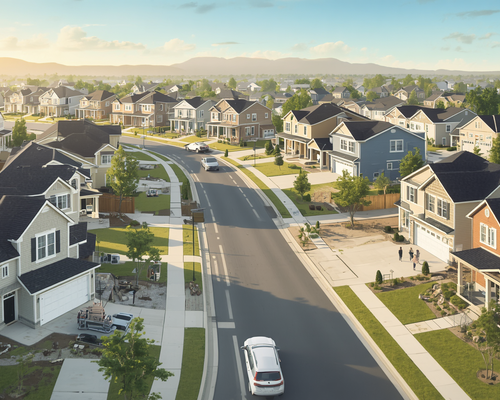
New-home sales fell sharply in April, showing new signs of stress in the U.S. housing market and the growing impact higher mortgage rates and affordability woes are having on would-be buyers.
Sales of newly built single-family homes plunged last month, wiping out some of the momentum seen earlier this year and showing how sensitive today's housing market has become to borrowing costs, new data from the Commerce Department showed.
The housing industry is at a critical point, and now comes the slowdown. Spring has traditionally been one of the busiest seasons for homebuying, but many buyers are finding themselves more and more priced out of the market as mortgage rates hover above 6.5% and home prices are near historically high levels.
The latest figures show housing demand is still there, but affordability has become the main factor dictating market activity across much of the country.
New-home sales fell about 10% in April to a seasonally adjusted annual rate of 625,000 units, well below economists' expectations. The decline marked one of the softest monthly performances in recent months and is indicative of the tough environment for buyers and builders alike.
Housing economists say a variety of factors are behind the slowdown. Mortgage rates have been climbing for most of 2026 as inflation fears, high Treasury yields, and global economic uncertainty have pushed borrowing costs higher. Even small rate increases can translate into hundreds of dollars of extra monthly housing costs for many families.
Many potential buyers are putting off purchases, cutting budgets, or leaving the market entirely.
For first-time buyers, the affordability challenge is particularly acute. First-time buyers today are not in the same position as existing homeowners who may have substantial equity or low-rate mortgages from years past, with higher financing costs, higher insurance premiums, higher property taxes, and higher everyday living expenses.
The result is a market in which demand persists but is becoming increasingly constrained.
Builders have spent much of the past year trying to overcome these affordability barriers. Many large homebuilders continue offering incentives such as mortgage-rate buydowns, closing-cost help, free upgrades and price cuts aimed at winning over buyers who might otherwise stay on the sidelines.
Those incentives have helped to support activity, but the latest sales figures suggest they are becoming less effective as borrowing costs remain high.
The median price of a new home sold in April increased to about $407,200 from $407,200, according to the government report, and the average sales price increased to about $518,400. Builders are increasingly focusing on smaller, less expensive homes, but price remains a major hurdle for many households.
Home prices are higher and rates on mortgages are higher, which has cut way down on buying power in just a few short years.
For example, a buyer buying a home at today’s median price with a mortgage rate above 6.5% will be making substantially higher monthly payments than a buyer buying a similarly priced home during the low-rate environment of 2021.
One of the defining characteristics of the 2026 housing market is the growing affordability gap.
The slowdown in new-home sales is notable given that new construction has been one of the brighter spots in housing over the past two years. Existing home sales have been constrained by the so-called “lock-in effect," where homeowners who locked in ultra-low mortgage rates during the pandemic do not want to sell and face higher borrowing costs.
That dynamic has constrained the supply of existing homes for sale, making new construction more important to meet housing demand.
But now the builders have their own problems.
Construction costs remain elevated due to higher labor costs, rising prices for materials, and ongoing supply chain issues. Recent tariff changes on steel, aluminum, and copper have also generated uncertainty about future construction costs, adding another layer of complexity for developers planning new projects.
Meanwhile, interest rates are high across the economy, and that means borrowing costs for builders are higher.
Those factors are making it more difficult for builders to ramp up production fast enough to help solve the nation’s chronic housing shortage.
New home inventory continues to climb despite weak sales numbers in April. There were about 504,000 new homes for sale at the end of the month, enough to last 9.6 months at the current sales pace.
That is a big jump from recent years and suggests builders are starting to hoard more inventory as sales cool.
Additional inventory may give buyers more choices, but not necessarily more affordability. Many builders are still reluctant to cut prices deeply, as construction costs are still high and profit margins already thin.
So the market is moving into a period where inventory is improving but affordability remains a big challenge.”
Economists are more often using terms such as “affordability-constrained” to describe today’s housing market than “supply-constrained.”
Limited inventory was the main thing holding back sales in recent years. But today, the homes are often there, but buyers are finding it difficult to afford them.
This is a significant change in how the housing market operates.
The broader economic environment is also a factor. Consumer confidence continues to be influenced by rising energy prices, concerns about inflation, and uncertainty about interest rates. Elevated borrowing costs and uncertain economic conditions have many households cautious about taking on large financial commitments.
As a result, the housing market has become very sensitive to changes in mortgage rates.
Small dips in rates often lead to an increase in buyer activity, while increases in rates often result in immediate declines in applications and sales.
Looking ahead, the outlook for new home sales will be highly contingent on the direction of mortgage rates and general affordability conditions.
If the summer is a hot market, builders may have to rely even more on incentives and price cuts to keep sales going. Lower borrowing costs could help activity to stabilize on the back of pent-up demand.
But for now, the latest sales figures are another reminder that affordability is the No. 1 problem in the U.S. housing market.
The housing market is not going down the tubes, but it is definitely under a lot of pressure. Demand is still there, inventory is getting better, and builders are still out there. But high mortgage rates and high home prices are holding back many households from taking the next step toward homeownership.
As June arrives, the market is stuck between a demand for more housing and the economic realities facing American buyers. Until affordability improves meaningfully, new-home sales are likely to remain vulnerable to every shift in mortgage rates and economic sentiment.

Discussion
Thoughts from readers and local market watchers.