



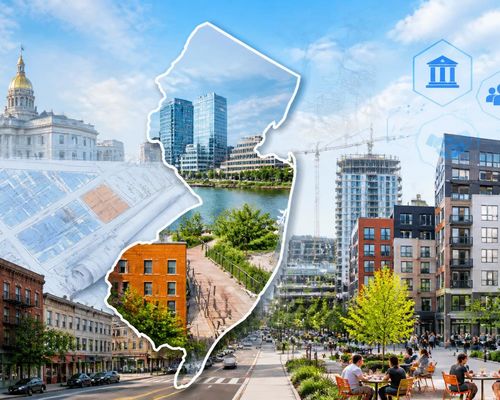
More and more suburban communities are becoming the epicenter of increasingly heated redevelopment discussions across New Jersey. Officials are pushing for strategies like denser housing, mixed-use projects, and long-term downtown revitalization. One of the latest and most closely watched examples is unfolding in Scotch Plains, where township leaders recently unveiled a sweeping downtown redevelopment proposal that is expected to reshape the community over the next decade.
The project is being led by Woodmont Properties, which would redevelop over nine acres of downtown Scotch Plains in a phased build-out expected to take between seven and 10 years. Township officials introduced the proposal during a public information session this week, detailing plans for new residential buildings, retail spaces, public plazas, parking improvements, and pedestrian-oriented streetscape upgrades.
While local officials say the project is a once-in-a-generation opportunity to modernize the township’s downtown district, the proposal also reveals the increasingly difficult balancing act many New Jersey municipalities face: how to add housing and economic development without overwhelming infrastructure or dramatically changing suburban character.
Township officials say the redevelopment plan is intended to turn aging public lots and underutilized properties into a more walkable mixed-use downtown that can attract businesses, residents, and investment while supporting long-term tax growth. The vision is part of a larger statewide push for transit-oriented development and denser housing near commercial centers.
Yet, as details of the proposal became known, so did concern among residents grow.
Community members asked about traffic congestion, parking availability, school capacity, stormwater management, and whether local infrastructure could realistically accommodate a significant increase in residential density over time. Others wondered whether the scale and pace of redevelopment were appropriate for a project with a 10-year timeline.
The concerns are reflective of a pattern that has been growing in recent years across New Jersey. With the state facing a housing shortage and growing affordability pressures, local governments are under pressure to allow larger residential developments — especially multifamily housing projects — while residents are pushing back against rapid suburban densification.
Redevelopment proposals have become politically sensitive issues in communities throughout Union County and beyond, capable of reshaping local elections, zoning battles, and planning board meetings. While residents generally favor downtown revitalization in principle, tensions flare when the proposals include hundreds of residential units, structured parking facilities, or taller mixed-use buildings adjacent to established neighborhoods.
Scotch Plains officials say the redevelopment strategy is vital to remaining economically competitive and modernizing a dated downtown that has struggled to fully leverage shifting consumer and housing preferences. Township leaders stressed during the presentation that the project would be phased in to minimize disruption and allow flexibility as conditions change over time.
The township’s selection of Woodmont Properties as its chosen redeveloper was itself the result of a multiyear process that included proposals from numerous developers. Local officials said the company was chosen in part because of its regional track record and experience with mixed-use redevelopment projects.
The redevelopment effort also reflects larger economic forces reshaping suburban New Jersey. High mortgage rates, limited housing inventory, and continued demand for commuter-friendly communities have intensified pressure to create additional housing supply. Developers and municipal leaders increasingly view downtown redevelopment as one of the few viable ways to add new residential units in already built-out suburban towns.
But many lifelong residents fear that redevelopment will change the character of their communities forever.
That tension is becoming one of the central political and planning issues in New Jersey real estate.
Cities across the state are grappling with how aggressively to pursue redevelopment while meeting affordable housing mandates and population growth pressures. Some towns are welcoming higher-density development as a move toward economic sustainability and housing expansion, while others are seeing organized resident opposition intensify over issues related to it.
What happens next could be an important test case of how suburban New Jersey communities approach redevelopment over the next decade. If successful, the project could serve as a model for downtown revitalization and mixed-use development. If the opposition persists, it could also serve as a stark reminder of how politically challenging dense redevelopment projects have become in some of the state’s most settled suburban communities.