


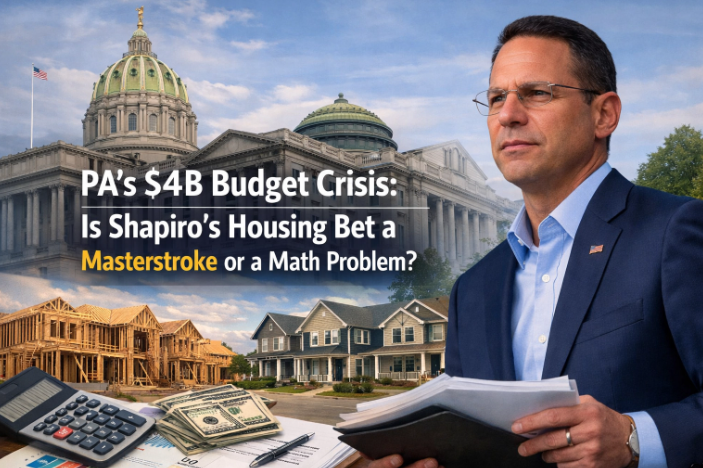
PA’s $4B Budget Crisis: Is Shapiro’s Housing Bet a Masterstroke or a Math Problem?
Pennsylvania is currently witnessing a fiscal tightrope walk that would make a circus performer nervous. Governor Josh Shapiro has unveiled a $53.2 billion budget proposal that doubles down on a massive $1 billion investment in housing and infrastructure. On the surface, it looks like a win for the real estate industry. Underneath, there is a $4.3 billion hole in the state’s pocket that threatens to turn this "investment" into a long-term liability for taxpayers and property owners alike.
The math is simple and slightly terrifying. The state is projected to spend billions more than it brings in this fiscal year. While the administration frames this as a proactive growth strategy, critics and fiscal watchdogs see it as a high-stakes gamble with the state’s financial stability. For real estate investors and homeowners, the question isn't just about whether new houses get built, but who ends up footing the bill when the music stops.
The Billion Dollar Housing Bet
Shapiro’s plan hinges on a $1 billion bonding initiative. The goal is to stimulate the economy by building new housing units and fixing crumbling infrastructure. It is a classic Keynesian move: spend money to make money. By increasing the housing supply, the administration hopes to attract more residents, stabilize prices, and eventually grow the tax base to pay off the debt.
This move comes at a time when the market is already feeling the squeeze. Investors are keeping a close eye on current mortgage rates and wondering if state-level intervention can actually move the needle in a meaningful way. While more inventory is generally good for the market, the method of delivery matters. Relying on debt to fix a supply issue is a strategy that assumes the economy will outrun the interest payments.
Raiding the Piggy Bank
To keep the lights on and the construction crews working, the administration is eyeing Pennsylvania’s $7 billion "Rainy Day" fund. This is the state’s emergency savings account, built up during years of federal pandemic aid and unexpected revenue surpluses. Tapping into these reserves to cover operational deficits is essentially the government version of paying your mortgage with your 401k.
The Independent Fiscal Office (IFO) has already raised the red flag. They project that the current $4.3 billion shortfall could balloon to $8 billion by the 2028-29 fiscal year. If the state drains its reserves now to fund a spending spree, it leaves zero margin for error if a genuine recession hits. This "raid" on the rainy day fund suggests that the current budget is less about sustainable growth and more about maintaining an expensive status quo.
Taxing Vice to Cover the Gap
Perhaps the most controversial part of the plan is how the state intends to find "new" money. The Shapiro administration is leaning heavily on the legalization and taxation of recreational marijuana and the regulation of "skill games." These are the ubiquitous gaming machines found in gas stations and bars across the Commonwealth.
Relying on "vice taxes" is a historically volatile strategy. While marijuana revenue has boosted coffers in states like Colorado and California, it rarely meets the sky-high initial projections. Furthermore, the political hurdles to legalizing recreational pot in Pennsylvania remain significant. Betting a billion-dollar housing plan on the hope that everyone starts buying more legal weed and playing more digital slot machines is a risky foundation for a state budget.
The Real Estate Reality Check
For the real estate community, the implications are mixed. On one hand, a $1 billion infusion into housing could spur development in underserved areas. On the other hand, a massive state deficit usually leads to one inevitable conclusion: higher taxes. If the state cannot bridge the $4 billion gap with marijuana and skill games, it will eventually look toward broad-based tax increases or property tax adjustments to balance the books.
We have seen similar legislative friction in other states. For instance, Massachusetts recently took legal action to enforce housing laws, showing how desperate states are becoming to solve the supply crisis. Pennsylvania is trying the carrot instead of the stick, but the carrot is being bought on credit.

Practical Impact: Who Wins and Who Loses?
The ripple effects of a $4.3 billion deficit and a $1 billion housing bond will be felt across every sector of the real estate market.
For Investors
Investors should be wary of the "long game" rhetoric. While new construction creates opportunities, the looming structural deficit increases the risk of future corporate tax hikes or changes to real estate transfer taxes. The stability that attracts cross-border capital is at risk when a state’s fiscal outlook is this cloudy.
For Homeowners
The immediate concern for homeowners is the potential for a "wealth tax" or increased property tax pressure. If the state’s rainy day fund is depleted and vice revenues underperform, the burden often falls back on the most reliable source of income: the property owner. This is particularly relevant as NH property owners and those in surrounding states deal with similar fiscal pressures.
For Buyers
A $1 billion investment sounds like it would lower prices, but government-subsidized housing often moves slower than the private market. Buyers might see some relief in terms of options, but if the state’s credit rating takes a hit due to the deficit, it could indirectly impact local lending conditions and overall economic confidence.
For Realtors
Realtors might see a temporary bump in transaction volume if the state successfully stimulates new development. However, trying to sell a state with a massive budget hole is a tougher pitch. High-net-worth clients often look at the fiscal health of a state before making long-term commitments.

The Declining Population Problem
The underlying issue that the Shapiro administration is trying to solve is Pennsylvania’s stagnating population. People are leaving, and the tax base is shrinking. This puts immense stress on the budget. The argument from the Governor's office is that by investing in housing and infrastructure, they can make Pennsylvania a "safe haven" for those fleeing higher-cost markets like New York or New Jersey.
It is a "build it and they will come" philosophy. But if the state becomes fiscally unstable in the process, the very people they are trying to attract might look elsewhere. High-income earners and mobile professionals are sensitive to tax environments. If they see a state raiding its savings account to fund a $1 billion experiment, they might prefer the relative stability of other markets.
What to Watch for in 2026
The next few months will be a tug-of-war between the Governor and the Republican-controlled Senate. Expect the $1 billion housing bond to be a major sticking point in budget negotiations. The "vice taxes" will also face heavy scrutiny, both from a moral and a mathematical standpoint.
Watch for the IFO’s updated revenue projections. If the deficit widens beyond $4.3 billion, the pressure to cut spending rather than increase it will become overwhelming. Also, keep an eye on how this budget impacts the state's bond rating. A downgrade would make the proposed $1 billion housing bond more expensive to service, effectively eating up the very funds meant for construction.
The real estate market in Pennsylvania is at a crossroads. We could see a period of government-led growth, or we could be witnessing the beginning of a fiscal correction that will hamper the market for years. For more insights on regional trends, check out our analysis on the North Jersey leasing boom, which offers a different perspective on how transaction volume is shifting in the tri-state area.
A Realistic Outlook
Pennsylvania is attempting to spend its way out of a demographic and fiscal hole. While the ambition is admirable, the math is currently working against the administration. The reliance on one-time reserves and hypothetical tax revenue from marijuana and gaming creates a fragile foundation for a housing revolution.
For those involved in the PA real estate market, the best strategy is cautious optimism paired with a heavy dose of fiscal awareness. The "masterstroke" of a $1 billion housing investment only works if you have the money to pay for it. Right now, Pennsylvania is looking for that money under the couch cushions and in the pockets of gamblers. Whether that is a viable long-term economic plan remains to be seen.
Stay updated on the latest shifts in the market by visiting our articles section or reaching out via our contact page for specific investment inquiries. The coming year will determine if Pennsylvania's housing bet pays off or if the state is simply digging a deeper hole.