



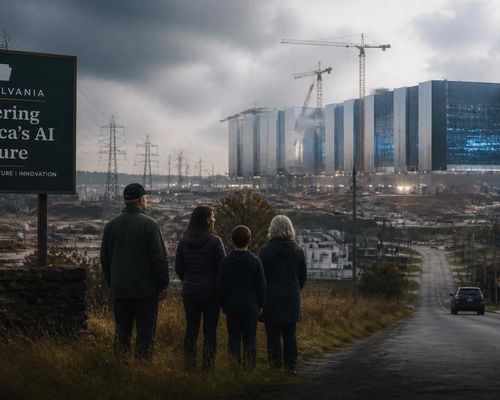
Pennsylvania is rapidly becoming one of America’s newest AI infrastructure hotspots — and the fight over massive data center developments is escalating fast.
Across the state, residents, developers, lawmakers, and environmental groups are increasingly clashing over the rapid expansion of hyperscale AI data centers that are beginning to reshape Pennsylvania’s real estate landscape.
One of the newest and most controversial flashpoints is unfolding near Conshohocken in Plymouth Township, where developers have revived plans for a massive 2 million-square-foot AI data center campus after earlier legal setbacks delayed the proposal.
The proposal has quickly become one of the most closely watched development battles in Pennsylvania because it reflects a much larger statewide debate surrounding AI infrastructure, zoning authority, electricity demand, environmental concerns, and the future of local development control.
What began as a niche commercial real estate trend has now evolved into one of the biggest political and economic stories in Pennsylvania heading into the second half of 2026.
Pennsylvania Is Becoming a Major AI Infrastructure Hub
Over the past year, Pennsylvania has quietly emerged as one of the fastest-growing targets for AI-related data center development in the country.
Developers and technology companies are aggressively pursuing sites across the state because Pennsylvania offers several major advantages, including relatively affordable land, proximity to East Coast population centers, extensive power infrastructure, and access to transportation networks.
The rise of artificial intelligence has dramatically increased demand for hyperscale data centers — enormous facilities packed with servers that power AI systems, cloud computing, and digital infrastructure. These projects require enormous amounts of electricity, cooling systems, water access, and industrial-scale land.
As AI adoption accelerates nationwide, developers are racing to secure strategic locations before available industrial land becomes more limited. Pennsylvania, particularly the eastern and northeastern parts of the state, is increasingly viewed as prime territory for expansion.
The Conshohocken-Area Proposal Is Becoming a Symbol of the Debate
The revived Plymouth Township proposal near Conshohocken has become one of the clearest examples of how controversial these projects are becoming.
According to recent reports, the proposed development would create a sprawling 2 million-square-foot data center campus capable of dramatically transforming the surrounding area.
The project was previously delayed following legal and zoning disputes, but developers have now returned with revised plans, reigniting strong opposition from many nearby residents.
Critics argue the project could increase traffic, strain infrastructure, raise energy demand, and permanently change the character of nearby neighborhoods. Some residents are also concerned about noise, environmental impacts, and the growing industrialization of suburban communities.
Supporters of the project, however, argue that the development could generate tax revenue, construction jobs, and long-term economic investment for the region.
The conflict has become increasingly emotional because many communities feel they are suddenly confronting industrial-scale developments that barely existed locally only a few years ago.
Local Governments Are Struggling to Keep Up
One of the biggest issues driving the controversy is whether local municipalities actually have enough authority to regulate or stop large AI infrastructure projects.
Across Pennsylvania, developers are increasingly pursuing zoning variances, industrial land conversions, and legal appeals to move projects forward even when local opposition remains intense.
Another proposed data center project in South Annville Township has also continued advancing despite local zoning complications and growing community concerns, further intensifying the statewide debate.
Many municipalities are now scrambling to determine how these facilities should be classified and regulated because most local zoning laws were written long before hyperscale AI facilities became a major development category.
That uncertainty is creating growing tension between local governments trying to preserve community control and state officials who want Pennsylvania to attract billions in AI-related investment.
Harrisburg Is Now Deeply Involved
The AI infrastructure boom has rapidly become one of the hottest political topics in Harrisburg.
Pennsylvania lawmakers are now debating multiple proposals involving energy usage, utility pricing, environmental oversight, zoning rules, and grid capacity tied directly to data center expansion.
Some lawmakers strongly support aggressive development, arguing that Pennsylvania has an opportunity to become a national leader in AI infrastructure investment. Others warn that unchecked expansion could create serious long-term consequences for electricity costs, infrastructure systems, and environmental sustainability.
The debate intensified after concerns emerged that hyperscale AI facilities could place enormous pressure on Pennsylvania’s electric grid. Data centers require massive amounts of constant power, and some analysts warn that future energy demand could eventually affect residential utility costs if infrastructure upgrades fail to keep pace.
Governor Josh Shapiro has recently emphasized that data center developers should help pay for the infrastructure needed to support these projects rather than shifting costs onto consumers.
That message reflects growing political pressure as Pennsylvania residents become increasingly concerned about rising electricity bills and infrastructure strain.
Environmental Groups Are Escalating Opposition
Environmental organizations are also becoming far more vocal as the pace of development accelerates.
Critics argue that hyperscale data centers consume enormous amounts of electricity and water while also requiring significant land development. Some advocacy groups are now calling for stricter statewide oversight, stronger environmental reviews, and tighter zoning protections before additional projects move forward.
Others are pushing for temporary moratoriums until Pennsylvania establishes clearer statewide regulations governing the growth of AI infrastructure.
The debate unfolding in Pennsylvania is becoming part of a much larger national conversation about how states should manage the explosive growth of artificial intelligence infrastructure while balancing economic development with environmental and community concerns.
Pennsylvania Could Become a National Test Case
The conflicts now unfolding across Pennsylvania may ultimately become a national model — or a warning sign — for how states handle the AI infrastructure boom.
The debate combines nearly every major issue shaping modern development battles today, including artificial intelligence, energy demand, zoning authority, environmental protection, infrastructure pressure, and local community resistance.
As more projects continue advancing across the state, Pennsylvania is increasingly positioning itself at the center of one of the most important emerging real estate and political stories in the country.
And with billions of dollars potentially at stake, the battle over AI data centers in Pennsylvania is likely only beginning.