


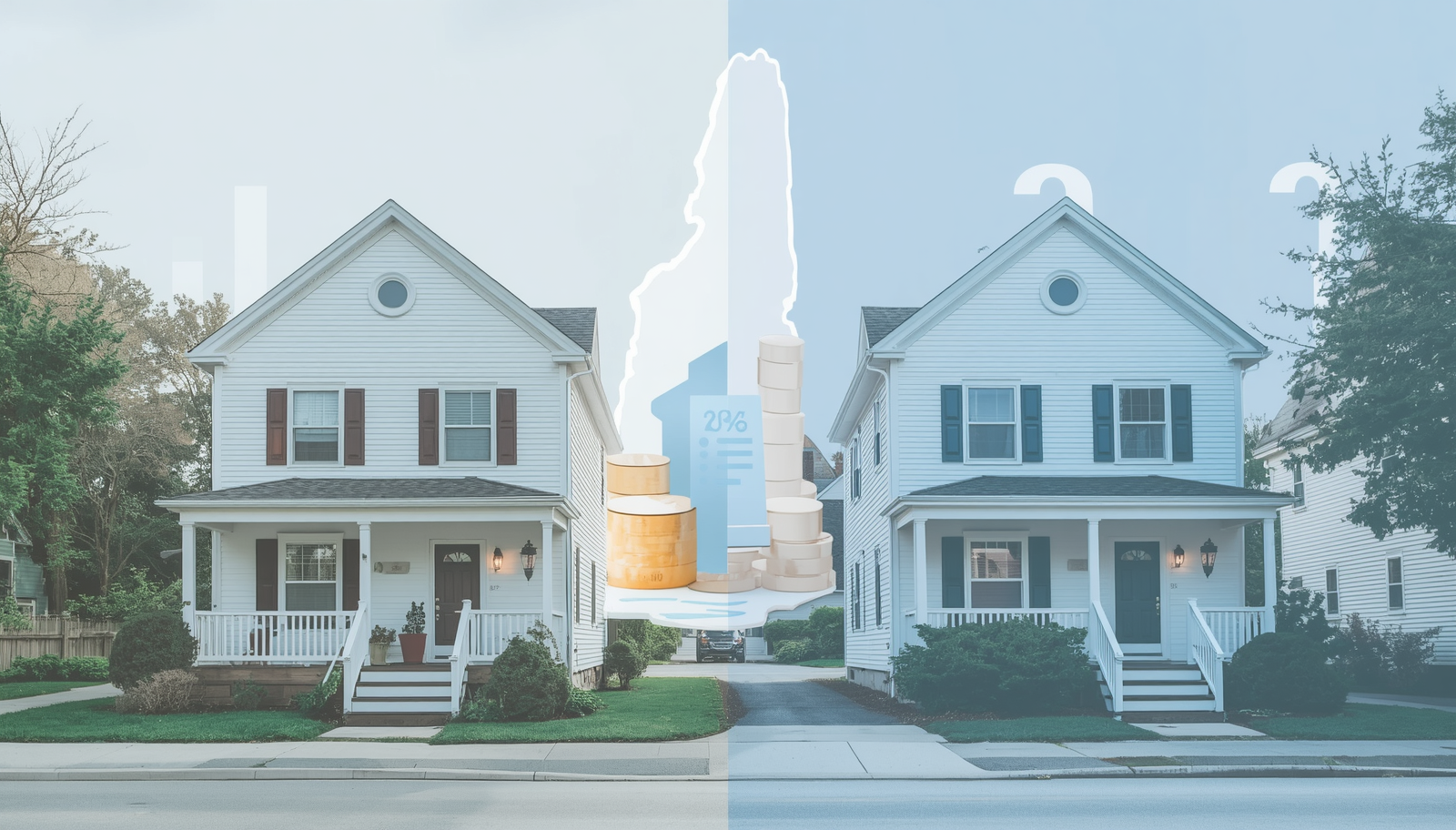
A new wave of data released in April 2026 is bringing renewed attention to a long-standing issue in New Hampshire — but one that is now having a more direct and visible impact on the housing market:
Property tax inequality across towns is becoming a defining factor in affordability.
While home prices and mortgage rates often dominate headlines, the latest analysis shows that where a home is located in New Hampshire can dramatically change the true cost of ownership — even when the homes themselves are nearly identical.
A State Where Location Changes Everything
According to recent findings from the New Hampshire Fiscal Policy Institute, property tax bills for similar homes can vary drastically depending on the municipality.
Some of the highest-tax municipalities in New Hampshire (2026) include:
- Charlestown – roughly $36+ per $1,000 of value
- Keene – about $34 per $1,000
- Berlin – around $33 per $1,000
- Canaan and Marlborough – both above $31 per $1,000
At the same time, some of the lowest-tax towns in the state include:
- Moultonborough – around $5 per $1,000
- New Castle – about $5–6 per $1,000
- Bartlett, Tuftonboro, Bridgewater – generally between $6–7 per $1,000
To put that into perspective:
On a $500,000 home
- In a high-tax town like Charlestown: ~$18,000/year
- In a low-tax town like Moultonborough: ~$2,500–$3,000/year
That’s a difference of $10,000–$15,000+ per year — for essentially the same home value. For a home valued around $500,000, annual property taxes can range from roughly $1,300 to more than $18,000, depending on location — a difference of nearly $17,000 for essentially the same asset.
Even neighboring towns can show sharp contrasts. In some cases, crossing a municipal boundary can result in thousands of dollars in annual tax differences, despite similar property values and housing characteristics.
This level of variation is not incidental — it is built into how New Hampshire funds its government.
Why New Hampshire Is Different
New Hampshire stands apart from most states in how it generates revenue. Unlike states that rely on income or sales taxes, New Hampshire depends heavily on property taxes to fund local services — particularly public education.
In fact, property taxes account for roughly 63–64% of all state and local government revenue, the highest share in the country.
This structure creates a system where:
- Local tax rates are tied closely to a town’s property values
- Communities with higher-value real estate can generate more revenue with lower tax rates
- Communities with lower property values often require higher tax rates to fund the same services
As a result, two towns with very different economic bases can produce vastly different tax burdens — even for similar homes.
The Real Estate Impact: Affordability Is No Longer Just Price
For buyers, sellers, and real estate professionals, this is no longer just a policy issue — it’s a market reality.
Affordability in New Hampshire is increasingly defined not just by the purchase price of a home, but by the total cost of ownership, including taxes. A home that appears affordable on paper can quickly become less so once property taxes are factored in.
This is already influencing buyer behavior.
Agents across the state are seeing more clients:
- Compare towns based on tax rates, not just home prices
- Expand searches into lower-tax municipalities
- Recalculate budgets after factoring in escrow and long-term tax costs
In practical terms, two homes listed at the same price can attract very different levels of interest depending on their tax burden.
A System That Hits Some Communities Harder
The latest analysis also highlights a broader concern: the system does not affect all communities equally.
Because property taxes are tied to local property values, towns with fewer resources often face higher relative tax burdens. These communities may struggle to generate revenue for schools and services, even while asking more of homeowners.
At the same time, wealthier communities — particularly those with strong commercial tax bases, tourism assets, or high-value real estate — are often able to maintain lower rates.
Researchers describe this as a structural issue, where the tax burden is influenced as much by geography as by income or home value.
There is also a broader equity concern. Lower- and middle-income households tend to pay a higher percentage of their income toward property taxes compared to higher-income earners, making the system more regressive than it may initially appear.
Why This Matters More in 2026
This issue is gaining momentum now because of where the housing market stands today.
New Hampshire is still dealing with:
- Limited housing supply
- Elevated home prices
- Rising insurance and ownership costs
In this environment, property taxes are becoming one of the few variables buyers can still control — by choosing one town over another.
That shift is subtle but important. It means demand may begin to redistribute based not just on location and lifestyle, but on tax efficiency.
For some towns, this could increase demand. For others — particularly those with higher tax burdens — it may create new challenges in attracting buyers.
Implications for Real Estate Professionals
For agents, investors, and developers, property tax variation is no longer a secondary detail — it is becoming a central part of the conversation.
In today’s market, professionals should expect:
- More detailed discussions around tax rates during buyer consultations
- Increased importance of net monthly payment comparisons across towns
- Greater emphasis on tax positioning in listings and marketing
For investors, tax rates can directly affect cash flow and long-term returns, especially in rental or multi-unit properties.
For developers, tax environments may influence where projects are viable — particularly for workforce housing.