



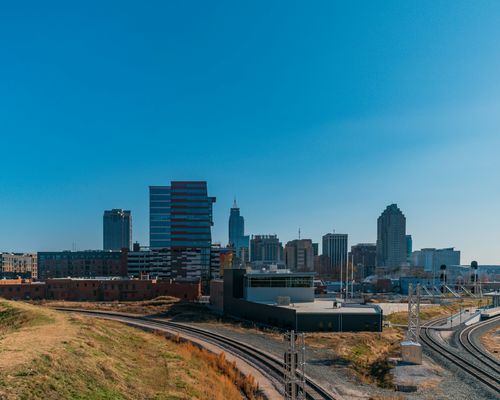
Two major redevelopment projects in Raleigh and Durham are poised to significantly reshape the housing landscape in the Triangle, with plans that could eventually deliver more than 1,000 homes across former public housing sites.
In Raleigh, the Heritage Park redevelopment is moving forward on an 11.6-acre site near downtown. The Raleigh Housing Authority's original community contained 122 apartments built in the 1970s, but the aging buildings were costly to maintain and the authority has pursued a larger redevelopment designed to create more housing while preserving a significant affordable component. RHA says the future community is expected to include roughly 550 to 900 units, with a mix of deeply affordable, income-restricted and market-rate housing.
The scale of the Raleigh project reflects the city's growing demand for housing and the increasing pressure to make better use of centrally located land. The redevelopment plan calls for greater density and mixed-use space, while the site's downtown and transit-oriented location allows substantially taller development. The project is intended to create a more walkable community while connecting residents to surrounding neighborhoods and services.
Heritage Park is already entering its first phase. The City of Raleigh says that phase includes 51 new senior housing units, supported in part by a $1 million city commitment. Ultimately, the broader redevelopment is expected to provide homes for approximately 1,000 residents. RHA also has a stated goal of replacing existing public housing on a one-for-one basis while expanding the city's affordable housing supply.
Durham is pursuing a similarly ambitious transformation at the former Forest Hills Heights public housing site near Durham Bulls Athletic Park. The proposed Tribute Rising project would turn the property into a multistage mixed-income, mixed-use neighborhood with up to about 900 homes. The development is being led in partnership with the Housing Authority of the City of Durham and the Integral Group.
The first phase of Tribute Rising is expected to include 333 homes, combining affordable and market-rate housing, along with nearly 12,000 square feet of local-serving retail. The larger vision includes restoring the street grid, adding green space and community amenities, and reconnecting the development with Durham's historic Hayti community. The project is currently expected to begin its first phase in late 2026.
The two projects illustrate a broader change taking place in North Carolina's growing cities. Instead of simply maintaining aging public housing complexes, local housing authorities are increasingly looking at higher-density, mixed-income redevelopment that can produce more homes on valuable urban land. For Raleigh and Durham, that approach could help increase housing supply while also bringing new investment into neighborhoods close to downtown employment, transit and entertainment districts.
The projects also highlight the challenge of balancing redevelopment with affordability. Both cities face rising housing costs, and simply adding market-rate apartments would not address the needs of lower-income households. Heritage Park's plans specifically call for at least 122 deeply affordable units, while Tribute Rising's first phase includes income-restricted housing alongside market-rate homes.
Bottom Line
Raleigh's Heritage Park and Durham's Tribute Rising represent more than two apartment developments. They show how older public housing sites are becoming opportunities for much larger, mixed-income communities in some of North Carolina's fastest-growing urban markets. If both projects advance as planned, they could add well over 1,000 homes while reshaping how Raleigh and Durham approach affordable housing, density and urban redevelopment.
Discussion
Thoughts from readers and local market watchers.