



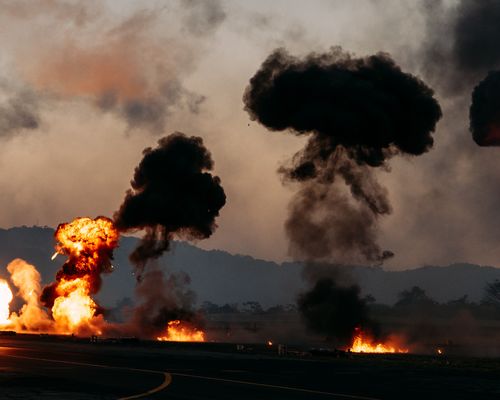
Russia launched a major overnight missile and drone attack against Kyiv early Thursday, killing at least five people and injuring more than 20 others, according to Ukrainian officials. The strikes damaged residential buildings, a children's hospital, a school and other civilian infrastructure across the Ukrainian capital, while fires broke out in multiple parts of the city.
The attack came as the war between Russia and Ukraine continues to intensify despite ongoing international efforts to find a path toward a ceasefire. Kyiv has faced increasingly frequent long-range attacks in recent weeks, with Russian forces relying heavily on ballistic missiles and drones to strike the capital and other Ukrainian cities.
Authorities reported that several districts of Kyiv were hit during the overnight assault. A fire broke out in a residential building, while additional structures, warehouses and non-residential facilities were damaged. A children's hospital was also affected, underscoring the continuing danger faced by civilians far from the front lines.
The latest attack follows a broader escalation in Russia's aerial campaign. Earlier this month, Russian forces launched another major assault involving dozens of ballistic missiles and more than 100 drones, killing at least 17 people in Kyiv and the surrounding region. Ukrainian officials have repeatedly warned that shortages of air-defense interceptors are leaving cities increasingly vulnerable to ballistic missile attacks.
The shortage of air-defense equipment has become one of Ukraine's most significant military challenges. Ukrainian President Volodymyr Zelenskyy has continued urging Western allies to provide additional Patriot missile interceptors and other systems capable of defending major population centers against Russia's ballistic missile arsenal.
The intensity of the attacks is also having consequences for Ukraine's economy. Previous Russian strikes have damaged warehouses, logistics centers, factories, energy infrastructure and retail distribution facilities, disrupting businesses and threatening jobs and supply chains. The destruction of commercial infrastructure makes the country's eventual economic recovery and reconstruction substantially more expensive.
The human cost has increased sharply as the war has entered another period of intensified long-range attacks. According to a recent United Nations assessment, civilian casualties in Ukraine rose by nearly 30% in July, with at least 437 civilians killed and 2,610 injured during the month. The UN said July represented the highest monthly civilian casualty total since May 2022.
Most of the recent casualties have occurred in urban areas away from the immediate front lines. The UN has attributed a significant portion of the deaths to long-range missiles and drones, while also reporting a sharp increase in casualties caused by aerial bombardment. Children have also been heavily affected, with 17 children killed and 166 injured in July, according to the UN assessment.
The conflict is simultaneously putting pressure on Ukraine's industrial economy. Russian attacks have repeatedly targeted infrastructure connected to manufacturing, energy and logistics. Earlier this month, a Russian strike damaged ArcelorMittal Kryvyi Rih, Ukraine's largest steel plant, forcing portions of its production operations to temporarily halt.
Russia is also facing growing economic consequences from the war. Ukraine has increasingly used long-range drones to attack Russian oil refineries, depots and other infrastructure. Those attacks have contributed to fuel shortages inside Russia, prompting Moscow to arrange gasoline imports and impose measures designed to protect domestic supplies.
Despite the continuing military escalation, diplomatic efforts have not completely disappeared. Ukrainian officials have continued communicating proposals to U.S. representatives, while Moscow has indicated that it remains open to future negotiations. However, there has been no durable ceasefire, and repeated attacks continue to demonstrate the difficulty of translating diplomatic discussions into a sustained reduction in fighting.
The latest attack also highlights the broader international consequences of the war. Continued fighting is affecting European security planning, government spending, energy markets, manufacturing and international aid commitments. As the conflict continues, governments across Europe and North America face the challenge of maintaining support for Ukraine while managing their own economic and security priorities.
For Kyiv's residents, however, the immediate concern remains survival. Overnight missile attacks have become a recurring reality, forcing residents into shelters as emergency crews respond to fires and damaged buildings. The latest assault shows that, despite years of international diplomacy and efforts toward a negotiated settlement, the war remains capable of producing devastating consequences in Ukraine's largest cities.
As Russia and Ukraine continue their military campaigns, the international community faces renewed pressure to pursue diplomatic efforts that could prevent further escalation. Until meaningful progress toward a lasting ceasefire is achieved, Ukraine's cities, economy and civilian population remain exposed to the continuing threat of long-range attacks.
Discussion
Thoughts from readers and local market watchers.