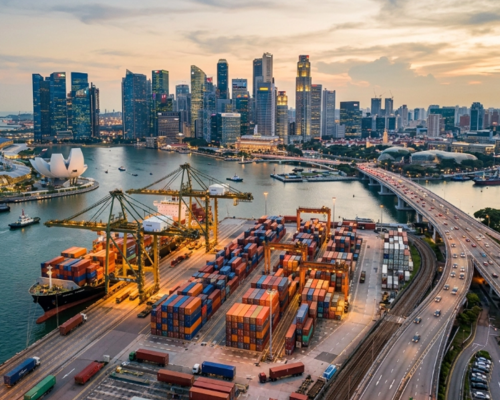
As we move through the second quarter of 2026, the international real estate landscape is facing a structural shift that was once relegated to academic theory: the practical reality of deglobalization. For years, investors operated under the assumption that capital and goods would move more freely over time, but the current wave of shifting trade policies and aggressive tariffs between the US, Europe, and Asia has fundamentally altered that trajectory.
According to a recent PwC industry report, roughly 70% of global real estate leaders now identify deglobalization and geopolitical instability as primary risks to their portfolios. This represents a significant jump from just three years ago, signaling that the "deglobalization trap": where cross-border investments face higher friction and lower predictability: is no longer a fringe concern but a central pillar of investment strategy.
The Trade Policy Ripple Effect
Trade policies do not just affect the price of consumer goods; they dictate the movement of the capital that fuels large-scale real estate developments. In 2026, we are seeing a marked increase in "protectionist real estate," where domestic policies favor local developers or penalize foreign institutional buyers through tiered tax structures. This creates a fragmentation in the market that makes the traditional global "safe haven" play more complex than it used to be.
The tightening of trade relations between the US and Europe has particularly impacted the commercial sector. When tariffs increase on construction materials or industrial components, the cost of finishing a project in London or New York can fluctuate by 15-20% within a single fiscal year. For investors, this means the risk-adjusted return on international assets requires a much higher buffer than in previous decades.

The Paradox of Global Capital in 2026
Despite these headwinds, there is a curious paradox at play. Data from the first few months of 2026 suggests that while trade is fragmenting, real estate capital remains surprisingly mobile: it is just becoming more concentrated. Institutional investors are moving away from broad "global" mandates and are instead hyper-focusing on specific jurisdictions that maintain high levels of transparency and legal stability.
This concentration of capital into a handful of "trusted" markets has led to a decrease in return dispersion across major transparent economies. Essentially, because 90% of global real estate capital is now crowding into the most stable liberal democracies to avoid trade-related volatility, those markets are seeing synchronized price movements. If you are looking to diversify geographically, you may find that traditional markets are now moving in lockstep, reducing the very diversification benefits you were seeking.
You can explore more about how these capital shifts affect different regions in our international category.
Nearshoring and the Industrial Real Estate Pivot
The most visible impact of deglobalization is the rise of "nearshoring." As companies pull their supply chains closer to home to avoid the unpredictability of transcontinental trade and tariffs, the demand for industrial and logistics space has shifted geographically. We are no longer seeing the same growth in traditional export hubs; instead, "border markets" and domestic manufacturing corridors are seeing a massive influx of demand.
In the US, this has bolstered markets that can support regional manufacturing, while in Europe, central and eastern European hubs are benefiting from the "de-risking" of supply chains away from distant manufacturing partners. For real estate investors, this means that the "industrial" label is no longer a monolith. The value of a warehouse is now directly tied to its proximity to resilient supply chains rather than its size or modern features alone.

Why Transparency is the New Gold Standard
In an era of shifting trade policies, the "transparency premium" has never been higher. When trade wars break out or tariffs are adjusted overnight, the legal framework of the country where your asset sits is your only true protection. Markets with opaque ownership laws or fluctuating tax codes are being heavily penalized by the market in 2026.
This is why we see continued interest in North American and Western European markets despite their lower yields compared to emerging economies. Investors are willing to pay a premium for "regulatory certainty." If you are analyzing a potential international play, the primary question is no longer "What is the yield?" but rather "How much can a change in trade policy erode my exit strategy?"
For those looking into how to protect these assets during volatile times, our section on asset protection provides a deep dive into the legal structures required for today's climate.
Practical Impact for Stakeholders
The current deglobalization trend affects every corner of the industry. Understanding how these macro shifts trickle down to local markets is essential for staying ahead of the curve.
Investors
International investors need to account for "tariff-adjusted cap rates." When analyzing a property, factor in the potential for rising maintenance and renovation costs due to trade restrictions. Diversification should focus on political stability and supply chain proximity rather than just geographic distance.
Realtors
Agents working with international clients must become experts in cross-border tax implications and the latest trade-related capital controls. Providing value now means understanding the "friction" of the transaction as much as the property itself. Check out our Ask the Expert section for more on navigating these complex client needs.
Buyers
For individual buyers looking abroad, the focus should be on "lifestyle" markets that are less dependent on industrial trade. Residential real estate in regions with strong local economies and minimal reliance on global manufacturing exports tends to be more resilient to the deglobalization trap.
Sellers
If you are selling an asset that typically attracts global capital, be prepared for a longer due diligence period. International buyers are scrutinizing "geopolitical risk" more than ever. Highlighting the stability of the local market and the resilience of the local supply chain can be a major selling point.
Homeowners
While it may seem distant, deglobalization affects your home's value through the cost of living and local employment. Markets tied to resilient, domestic-focused industries are likely to see more stable property values than those reliant on global trade hubs.
What to Watch: The Outlook for Late 2026
As we look toward the end of the year, several key indicators will determine if the "deglobalization trap" tightens or loosens. The primary factor will be the next round of trade negotiations between the major economic blocs. If we see a move toward "regionalism": where trade flows freely within blocs but is restricted between them: real estate demand will follow suit, creating distinct "economic islands."
Watch the construction cost index closely. If tariffs on steel and timber continue to climb, we will likely see a slowdown in new developments, which will squeeze supply and keep prices high in established markets. This "supply shock" is a secondary effect of deglobalization that many haven't fully priced in yet.
Finally, keep an eye on the movement of sovereign wealth funds. These entities are the bellwethers of global capital. If they continue to pull back from "global" portfolios in favor of domestic or regional infrastructure and real estate, it will confirm that the deglobalization trap is the new permanent reality for the foreseeable future.
The global real estate game hasn't ended; it has simply changed the rules. The winners in 2026 will be those who stop waiting for a return to the "old normal" of seamless global trade and instead start building portfolios that thrive on regional resilience and regulatory transparency. The deglobalization trap is only a trap if you aren't looking where you’re stepping. Moving forward, the most valuable asset in your portfolio isn't just the land or the building: it is the knowledge of the political and economic architecture that surrounds it.