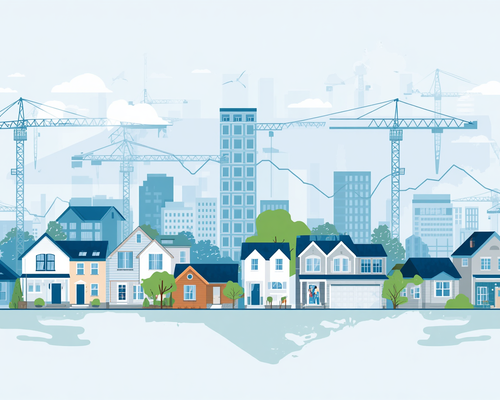
For the first time in years, the housing market is starting to feel different across North Carolina’s Triangle.
Homes are sitting longer.” Buyers are becoming more aggressive negotiators. Price reductions are occurring with increasing frequency. And the breakneck pace that used to define the Raleigh-Durham housing market is slowly being replaced by something much more balanced.
It’s not a crash.” It is not a collapse. But it’s a big change, and it’s changing the way buyers, sellers, agents, and investors are thinking about the market in 2026.
The latest market data shows homes in the Raleigh area now take significantly longer to sell than they did at the height of the pandemic. Homes in Raleigh averaged about 68 days on the market before going under contract, according to a new RE/MAX analysis, ranking the market among the top U.S. housing markets for gains in days on market.
That one number tells an important story.
Not too long ago, homes throughout the Triangle were selling within days, sometimes hours, of hitting the market and receiving multiple offers. Buyers routinely waived contingencies, bid well above asking price, and battled for properties in bidding wars fueled by low mortgage rates and surging migration to the region.
The market is a very different place now.
From Frenzy to Friction.
The Triangle is one of the hottest housing markets in the country during the pandemic-era housing boom. Demand far outstripped supply in an environment of rapid population growth, corporate relocations, tech expansion, and historically low mortgage rates.
Buyers flocked to Wake, Durham, and Johnston counties in a heated race to lock in homes before prices soared even higher.
But markets that rise quickly tend to slow down eventually, and that’s what’s starting to happen now.
Many buyers have seen their affordability calculations get pushed much higher with higher mortgage rates. Home prices are still high across much of the Triangle, but borrowing costs are much higher than during the ultra-low-rate years of 2020 and 2021.
That move has brought more reluctance into the market. Buyers are taking longer to make decisions, weighing pricing, financing, and monthly payments carefully rather than rushing in with offers.
The result is a market that seems more sedate but also more complex.
Inventory is finally getting better
One of the biggest reasons for the market slowdown is the rise in available inventory.
Recent Wake County listings are up more than 20% from a year ago, giving buyers more options than they’ve had in years.
Much of the pandemic boom had so little inventory that buyers often felt compelled to settle just to compete. Demand was phenomenal, and in many cases homes were selling regardless of condition, presentation, or pricing strategy.
With more homes to choose from, buyers are becoming picky.
“Some homes just sit longer. They’re overpriced, badly staged, and in less competitive areas. Sellers who are counting on bidding wars like 2021 are having to temper expectations more and more.
At the same time, well-priced, move-in-ready homes continue to draw strong interest, especially in desirable neighborhoods with access to employment centers, schools, and amenities.
That split is becoming one of the hallmarks of the market today.
A "Strategy Market" is Emerging
Agents across the Triangle are increasingly using the same phrase to describe the current environment: a strategy market.
Strategy mattered less than speed during the pandemic surge. Buyers were quick, and sellers generally had the upper hand regardless of how it was presented or priced. Today, success depends much more on execution.
Pricing strategy has become critical again. Sellers who overprice properties are seeing longer days on market and more reductions. Marketing quality, staging, and property condition are carrying more weight as buyers compare a larger pool of available homes.
Financing needs are also playing a far bigger role in the negotiations. With mortgage rates in the mid-6% range, buyers are payment sensitive, and affordability calculations are often determining how hard buyers can compete.
This shift is creating a more traditional real estate market—one in which negotiation, preparation, and local market knowledge are far more important than they were during the frenzy years.
The Market Is Cooling; Demand Still Strong
The Triangle market isn’t considered weak by most analysts, even with the slowdown.
Long-term demand drivers remain firmly in place.
The region still enjoys:
- Solid job growth
- Business investment
- Population migration.
- Growth of healthcare, biotech and technology
Large-scale developments and institutional investments continue to push forward throughout Raleigh, Durham, Cary, and surrounding suburbs. “Companies are still growing operations in North Carolina, and there’s still migration from higher-cost states.”
But that demand is helping keep the market from falling apart even as activity slows from pandemic-era highs that weren't sustainable. Much of what is happening now is less about decline and more about normalization.
Why this is important is less about decline and more about normalization.
Why This Shift Matters
The transition toward a more balanced market carries important implications for the broader The transition to a more balanced market has important consequences for the broader housing landscape.For buyers, better inventory and slower competition translate into more opportunity and bargaining power than they have seen in years.g inventory and slower competition create more opportunity and negotiating power than they’ve had in years.
But the environment is becoming less seller-friendly. The right pricing, marketing, and change also have implications for risk calculations for investors and developers. Slower absorption rates, more cautious buyers and rising financing costs are forcing more disciplined decision making.buyers, and rising financing costs are all forcing more disciplined decision-making.
At the same time, affordability remains a major challenge. Even though competition has eased somewhat, prices are still elevated compared to pre-pandemic levels, and mortgage rates continue limiting purchasing power for many households.
A Market Entering a New Phase
The Triangle housing market is not operating under the extreme conditions of the early 2020s.
Instead, it is moving into a new phase, one driven less by panic buying and more by balance, affordability pressures, and strategic decision-making.
It may seem dramatic after years of fierce competition, but many in the industry view it as a healthier long-term direction for the market.
The days of instant home sales and multiple bids may be ending. But the Triangle’s bigger growth story is very much alive.