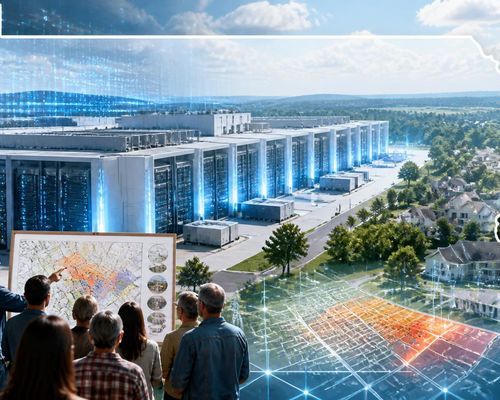
The state’s burgeoning AI data center industry is facing rising backlash across Pennsylvania, as residents, local officials, environmental groups and lawmakers push back against what many characterize as a tide of industrial-scale development sweeping through communities with little public input.
What was seen largely as an opportunity for economic development is becoming one of Pennsylvania's most contentious political fights over real estate and infrastructure.
All across the state, communities have been flooded with proposals for massive hyperscale data centers in recent months, driven by the explosive growth in artificial intelligence, cloud computing and supercharged digital infrastructure. Aggressive development has targeted Pennsylvania for its vast supply of industrial land, existing electrical infrastructure, geographic proximity to major East Coast markets and relatively low development costs compared to adjacent states.
But opposition is rising as quickly as projects are moving ahead.
Recent reports say public meetings and town halls across Pennsylvania have become more confrontational as residents accuse developers and state officials of trying to push projects through without fully addressing concerns over environmental impact, strain on infrastructure, rising utility costs and local zoning authority.
Sometimes the frustration has been intensely personal and politically charged.
In recent public meetings, several residents publicly denounced Governor Josh Shapiro for his support of expanding AI infrastructure development throughout Pennsylvania. Some in the community said they feel “bulldozed” by projects that they feel are being prioritized too quickly without enough safeguards or local control.
The growing debate shows how artificial intelligence is not just a technology story anymore. It’s rapidly becoming a major real estate, infrastructure and political issue in Pennsylvania that could reshape communities for decades.
Pennsylvania Is a Nice Target for AI Expansion
The wave of development proposals illustrates how rapidly the infrastructure needs of the AI industry are expanding across the country.
Artificial intelligence systems require huge amounts of computing power, and that computing power depends on hyperscale data centers full of servers running 24/7. These facilities demand huge amounts of electricity and water, as well as massive cooling systems and industrial-scale infrastructure.
Pennsylvania has become one of the most attractive places for developers because the state has several important advantages. The abundance of available industrial land in Pennsylvania, accessibility to transmission infrastructure, abundant natural gas resources, and proximity to population-dense East Coast markets have made the state increasingly attractive to technology companies and infrastructure investors.
Now developers are very interested in sites in eastern, central, and northeastern Pennsylvania that could house massive facilities related to artificial intelligence.
Initially, some local officials backed the projects, lured by the promise of construction jobs, tax revenue, and long-term investment. But now the scale and speed of expansion are leaving residents increasingly anxious that communities are unprepared for the long-term consequences.
Residents are complaining about electricity, water, and noise
One of the largest public concerns is the massive amount of electricity needed to power AI infrastructure.
Data centers consume power at an industrial level 24 hours a day, and residents fear future demand could one day raise utility costs for homes and small businesses if infrastructure upgrades don’t keep pace.
Some Pennsylvania lawmakers and utility experts have already warned the rapid expansion of AI infrastructure could put major strain on the state's electric grid in future years.
Water use has also become a big issue.
Large data centers often require extensive cooling systems that use a lot of water, particularly in the warmer months. In several Pennsylvania communities, residents have questioned whether local infrastructure can realistically support multiple hyperscale facilities without impacting surrounding neighborhoods and environmental resources.
Noise pollution has also been a subject of growing controversy.
Data centers often are pitched as relatively quiet industrial developments, but critics say the facilities can generate constant low-frequency noise from cooling systems, backup generators, and ventilation equipment that run around the clock.
In suburban and rural communities not used to industrial-scale infrastructure, the projects can feel jarringly out of place.
Many residents’ municipalities have zoning laws that were written long before hyperscale AI facilities were a common development category, they say, adding to their frustration. That ambiguity is creating confusion over how local governments should classify, regulate, or possibly reject these projects.
Debate heats up in Harrisburg
Now the fight has grown so large that it is becoming a big political issue in Harrisburg.
As more projects move forward, the question of whether tougher statewide regulations are needed is a growing topic of discussion among Pennsylvania lawmakers. Some officials are even talking publicly about imposing temporary moratoriums on some large data center projects until more sweeping rules can be adopted.
At present, there are several proposals being discussed:
- infrastructure cost sharing requirements,
- energy use regulations,
- environmental accounting standards,
- zoning supervision
- and protections on utility rates.
The issue mirrors a wider division between those who see the AI infrastructure as a huge economic opportunity and those who are afraid Pennsylvania is moving too fast without knowing what the long-term effects might be.
Supporters of the expansion say Pennsylvania can become one of the country’s leading AI infrastructure centers as the world’s demand for computing power surges.
Critics say local communities shouldn’t have to pay the environmental and infrastructure costs for projects that largely benefit big tech and investment companies.
Pennsylvania Could Show the Nation the Way
What is playing out in Pennsylvania is increasingly echoing national tensions over artificial intelligence development.
Across the United States, communities are beginning to grapple with the physical infrastructure needs to support the AI economy. While much of the public discussion around AI focuses on software and digital technology, the industry’s rapid growth is also creating enormous pressure on land use, energy systems, water resources, and commercial real estate markets.
Pennsylvania is now near the center of that national conversation.
Across the state, simmering conflicts mix many of the defining issues shaping modern development fights:
- rapid technology growth,
- local zoning authority,
- environment protection,
- infrastructure stress,
- increasing utility problems,
- and community resistance to large-scale industrial growth.
As more projects continue moving through the approval process, the debate surrounding AI infrastructure in Pennsylvania is likely to intensify even further.
The stakes are high, with billions of dollars in future investment potentially at risk, and the outcome could have ripple effects not only on Pennsylvania’s economy and real estate market but also on how other states respond to the growing demands of the artificial intelligence era.