



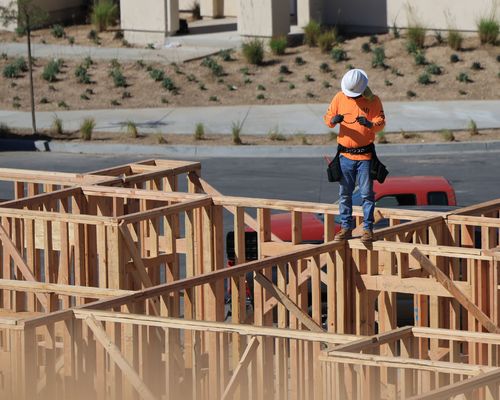
The U.S. housing market is facing a new challenge that could have lasting consequences for affordability and future home availability. New government data released Tuesday showed that home construction activity slowed sharply in May, highlighting growing concerns among builders about rising costs, elevated mortgage rates, and weakening buyer demand.
According to the Commerce Department, total housing starts plunged 15.4% in May to a seasonally adjusted annual rate of 1.177 million units, marking the weakest level since the early months of the pandemic in 2020. The decline was significantly steeper than economists had expected and represents one of the largest monthly drops in construction activity seen this year. (per Reuters)
The report signals that builders are becoming increasingly cautious as they navigate one of the most challenging housing environments in recent years.
Single-family housing starts, which account for the majority of homeownership opportunities in the United States, declined 1.9% to an annual pace of 882,000 units, the lowest level in eight months. While the drop was relatively modest compared to the broader market, it reflects growing hesitation among builders who are struggling to balance rising construction expenses with slower sales activity. (per Reuters)
The biggest weakness came from the multi-family sector.
Construction starts for apartments and other multi-family housing projects collapsed 41.6% during the month, contributing heavily to the overall decline in residential construction. The sharp drop suggests developers are becoming more cautious about launching large-scale projects amid higher financing costs and uncertainty about future demand. (per Reuters)
The slowdown comes at a time when many builders are already facing mounting challenges.
Mortgage rates remain near 6.6%, significantly higher than the levels many buyers became accustomed to during the pandemic-era housing boom. Those higher borrowing costs have dramatically reduced purchasing power for prospective homeowners and have forced many households to delay or abandon plans to purchase a home altogether.
At the same time, construction companies continue grappling with rising material costs, labor shortages, higher insurance expenses, and increasing financing costs for new developments. Recent tariff changes affecting imported steel, aluminum, and copper have also created additional uncertainty about future building expenses.
For builders, the result is a difficult balancing act.
While the United States continues to face a significant housing shortage, many developers are finding it increasingly difficult to justify launching new projects when affordability challenges are limiting the pool of qualified buyers.
The latest construction data reflects those concerns.
Builder confidence has weakened throughout much of 2026 as sales activity remains inconsistent and buyers become increasingly sensitive to monthly payment costs. Many builders have responded by offering mortgage-rate buydowns, closing-cost assistance, and price reductions in an effort to keep inventory moving.
Yet even with those incentives, demand remains uneven.
According to recent industry surveys, buyer traffic remains subdued in many markets, particularly among first-time homebuyers who are most affected by today's elevated mortgage rates. Builders are also reporting that homes are taking longer to sell, forcing some companies to delay future projects until market conditions improve.
The decline in housing starts is particularly important because it comes despite a continued need for additional housing supply.
For years, economists have pointed to a shortage of homes as one of the primary reasons housing affordability has deteriorated across the country. Following the 2008 financial crisis, homebuilding activity remained below historical norms for more than a decade, creating a structural supply deficit that still affects the market today.
Many housing analysts estimate the nation remains short by millions of homes.
The concern now is that today's construction slowdown could worsen that problem in the years ahead.
When builders reduce new construction activity, fewer homes enter the market in future months and years. That can create additional upward pressure on prices once buyer demand eventually recovers. In other words, even though affordability challenges are currently suppressing demand, reduced construction today could help sustain affordability problems over the long term.
Economists are increasingly warning about this dynamic.
The housing market appears to be caught in a difficult cycle where high mortgage rates are discouraging buyers, which in turn discourages builders from constructing new homes. But fewer new homes ultimately make it harder to improve affordability because supply remains constrained.
Recent permit data offers only limited reassurance.
Building permits, which serve as a leading indicator of future construction activity, increased slightly during May. However, the modest improvement was not enough to offset concerns created by the sharp decline in housing starts. Many analysts believe builders will remain cautious until borrowing costs fall or demand strengthens more consistently.
The broader economic environment is also influencing builder decisions.
Inflation remains above the Federal Reserve's target, and a growing number of economists now believe the central bank may keep interest rates elevated through the remainder of 2026. Higher-for-longer interest rates translate into higher mortgage rates, which continue to weigh on housing demand.
Meanwhile, rising energy costs linked to ongoing geopolitical tensions have increased transportation and construction expenses throughout the economy.
For many builders, the combination of weak affordability, higher financing costs, and economic uncertainty is creating an environment where preserving capital is becoming a higher priority than aggressive expansion.
The latest housing starts report underscores how quickly sentiment has shifted within the industry.
Just a few years ago, builders were racing to meet surging demand fueled by historically low mortgage rates and pandemic-driven migration trends. Today, many are focusing instead on managing inventory, protecting margins, and carefully evaluating future projects.
Despite the slowdown, housing experts do not view the current situation as a collapse in construction activity. Rather, they see it as a market adjusting to a very different financial environment than the one that existed during the housing boom.
Builders are still constructing homes. Buyers are still purchasing properties. But the pace of activity has slowed considerably as both sides adapt to higher borrowing costs and tighter affordability conditions.
The challenge is that the nation still needs more housing.
Until construction activity rebounds meaningfully, the supply shortages that have contributed to years of rising home prices are unlikely to disappear. That means affordability may remain one of the housing market's biggest challenges even if mortgage rates eventually decline.
The latest report serves as a reminder that housing affordability is not simply a demand issue. It is also a supply issue, and the sharp decline in homebuilding activity suggests that solving America's housing shortage may become even more difficult in the years ahead.
As summer begins, the housing market finds itself at a crossroads. Buyers are struggling with affordability, builders are pulling back on new projects, and policymakers continue searching for solutions to a shortage that has become one of the nation's most persistent economic challenges.
For now, the message from the latest construction data is clear: homebuilding is slowing, and that could have significant implications for the future of the U.S. housing market.

Discussion
Thoughts from readers and local market watchers.