



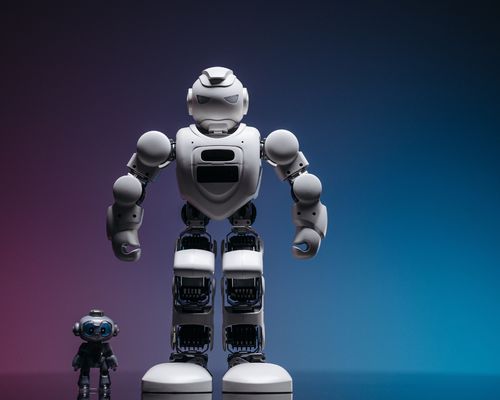
China's rapidly expanding humanoid robotics industry has reached a major milestone after Unitree Robotics made a spectacular debut on the Shanghai Stock Exchange, sending its shares soaring by more than 600% and pushing the company's market valuation to roughly $50 billion. The extraordinary market reaction underscores growing investor confidence that artificial intelligence is moving beyond software and into machines capable of interacting with the physical world.
Unitree raised approximately 6.1 billion yuan, or about $904 million, through its initial public offering on Shanghai's STAR Market. The company became the first major mainland-listed humanoid robot manufacturer, giving investors a new way to participate directly in China's rapidly developing robotics sector.
The stock's performance was extraordinary. Shares climbed as much as 629% during their first trading session before closing roughly 460% higher. The rally gave Unitree a valuation near $50 billion, dramatically above the company's IPO valuation and demonstrating just how much enthusiasm investors currently have for artificial intelligence and robotics.
The market reaction comes at a time when China is aggressively positioning itself as a global leader in humanoid robotics, a field that combines artificial intelligence, advanced sensors, computer vision, mechanical engineering, batteries, semiconductor technology and autonomous systems.
Unitree has become one of the most recognizable companies in that race. Its robots have gained international attention for performing activities such as walking, running, dancing, boxing and martial arts, demonstrating increasingly sophisticated movement and balance. The company has also developed quadruped robots in addition to its humanoid machines, giving it experience across multiple categories of robotic systems.
The company's chief executive, Wang Xingxing, said Thursday that the robotics industry could be approaching a "ChatGPT moment" for robot intelligence. The comparison is significant because ChatGPT demonstrated how rapidly artificial intelligence could move from a specialized technology into a mainstream consumer and business platform. Unitree's leadership believes a similar transition could eventually happen with robots as AI systems become capable of understanding environments, learning tasks and operating more independently.
That transition, however, is still in its early stages.
Many humanoid robots currently remain better at demonstrations than at performing complicated real-world work consistently. Researchers and industry observers continue to identify major challenges involving dexterity, reliability, battery life, navigation, safety and artificial intelligence. A robot that can perform a choreographed demonstration is very different from one that can safely operate for eight hours inside a factory, warehouse, hospital or home.
Unitree's financial performance nevertheless demonstrates that investors believe those obstacles can eventually be overcome. The company reported approximately 1.7 billion yuan in revenue in 2025, with more than 40% coming from overseas sales, showing that its business already extends beyond China's domestic market.
The company's IPO also provides capital that can be used to accelerate research, manufacturing and commercialization. Unitree plans to expand its production capabilities and invest in technology as demand for robots continues to grow.
China's broader robotics strategy is another important part of the story. The country has spent years building extensive manufacturing capabilities in electronics, batteries, motors, sensors and industrial automation. Those supply chains provide an important foundation for humanoid robotics, potentially allowing Chinese companies to manufacture advanced machines at lower costs as production scales.
The timing of Unitree's IPO also coincides with the 2026 World Robot Conference in Beijing, where thousands of robotic products are being showcased. Chinese companies are using the event to demonstrate advances in humanoid machines while attempting to shift the industry's focus from impressive demonstrations toward commercially useful applications.
The economic implications could be substantial if humanoid robots eventually become commercially viable at scale.
Manufacturing is an obvious early application. Robots could perform repetitive, dangerous or physically demanding tasks, allowing companies to increase production while reducing exposure to workplace injuries and labor shortages. Warehousing, logistics and construction could also benefit from machines capable of lifting materials, moving equipment and performing repetitive physical tasks.
The technology could eventually affect the housing and construction industries as well. Construction companies around the world continue to face shortages of skilled workers and rising labor costs. If humanoid robots become capable of performing basic construction tasks safely and efficiently, they could eventually supplement human workers and potentially reduce the time and labor required for certain projects.
However, that possibility remains years away for many applications. Today's systems are still expensive, relatively limited and dependent on significant human oversight.
The international competition surrounding the technology is also intensifying. China is competing against companies including Tesla, Boston Dynamics and other robotics developers seeking to establish leadership in humanoid machines. At the same time, governments increasingly view advanced robotics as a strategic technology because of its potential applications in manufacturing, defense, logistics and national infrastructure.
Geopolitical tensions are already affecting the industry's development. The United States has introduced restrictions affecting imports of certain foreign-made humanoid and quadruped robots, citing national security concerns. Those policies could limit Unitree's ability to expand in the American market while encouraging Chinese companies to focus more heavily on domestic demand and other international markets.
The enormous increase in Unitree's stock price also raises an important question for investors: How much of the company's future growth is already reflected in its valuation?
A roughly $50 billion valuation places extraordinary expectations on a company whose commercial humanoid robotics industry is still developing. Investors are effectively betting that the technology will advance rapidly, production costs will fall, and demand will eventually expand dramatically.
That makes Unitree's debut both an investment story and a technology story.
The rally demonstrates that investors are beginning to treat physical AI as a potentially enormous market rather than simply another branch of experimental robotics. If artificial intelligence provides the "brain" for increasingly capable machines, robotics companies could become the manufacturers of the physical workforce that operates alongside humans.
The next several years will determine whether that vision becomes reality.
For now, Unitree's extraordinary debut is sending a clear message: China wants to lead the next phase of the AI revolution, and that phase may not happen entirely inside computers. It may happen in factories, warehouses, hospitals, construction sites and eventually homes.
The rise of humanoid robotics could therefore represent something much larger than a new technology category. It could become the next major transformation in how businesses operate, how labor is performed and how economies produce goods and services.
Unitree's $50 billion market valuation may ultimately prove either wildly optimistic or remarkably prescient. But the company's first day on the Shanghai exchange has made one thing increasingly difficult to ignore: the global AI race is moving from digital intelligence toward machines that can physically act on the world around them.
Discussion
Thoughts from readers and local market watchers.