



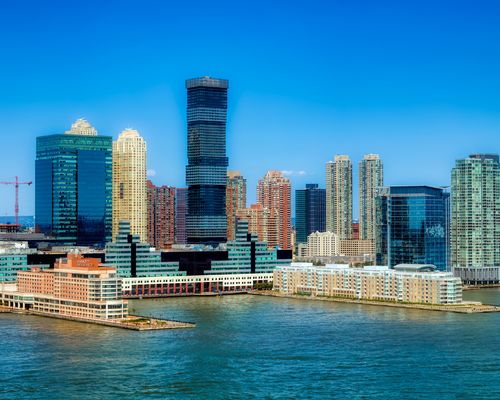
A major new development is poised to reshape Jersey City's downtown as developer Esen unveils new plans for a roughly 2,000-unit mixed-use project at 310 Washington Street, turning an existing surface parking lot into a large residential and public-space district.
The multiphase project, being developed in partnership with global transportation company Evergreen, is expected to transform the property just two blocks from the Hudson River. Esen hopes to begin construction this year, adding thousands of new rental homes to one of New Jersey's most active housing markets.
The development is expected to include apartments ranging from studios to three-bedroom units, along with retail space and more than one acre of park and courtyard space. Plans also call for a pedestrian-only promenade connecting Washington and Greene streets and a central plaza that could host community markets, live music, movie nights, and other neighborhood events.
For Jersey City's housing market, the scale of the project is significant. Thousands of additional apartments are already being developed throughout the city, but demand for rental housing remains strong because of Jersey City's proximity to Manhattan, extensive PATH transportation, and growing employment and retail infrastructure.
The 310 Washington Street project will also benefit from its location near the Grove Street and Exchange Place PATH stations, putting future residents within easy reach of Manhattan as well as Jersey City's expanding downtown business and retail districts.
The development is particularly notable because it will replace a large surface parking lot with a much denser mixed-use neighborhood. That reflects a broader trend across New Jersey, where developers and municipalities are increasingly looking to redevelop underused urban land to create housing rather than expanding into undeveloped areas.
Esen says the project will comply with the site's existing zoning and will not require a tax abatement or payment-in-lieu-of-taxes agreement. Once fully built, the development is expected to generate more than $15 million in annual permanent tax revenue, potentially providing a substantial boost to Jersey City's tax base and helping support municipal services and public schools.
The project also arrives during a period when financing conditions remain challenging for large-scale residential development. Higher interest rates, construction costs, and tighter lending standards have made it more difficult for developers to secure funding for major projects.
Yet Jersey City's continued ability to attract large residential investments suggests that developers and capital providers remain confident in the city's long-term fundamentals.
The 310 Washington Street project is not the only major development moving forward in Jersey City. Just days earlier, developers of another planned downtown tower secured a nearly $277 million construction loan for a 69-story, 748-unit Urby project at 201 Hudson Street. Together, the projects demonstrate the enormous scale of multifamily development still taking place in the city.
For real estate professionals across New Jersey, the latest announcement is an important signal about where housing growth is concentrating. Jersey City's combination of transportation access, proximity to New York City, employment opportunities, and established urban infrastructure continues making it one of the state's strongest markets for large-scale multifamily investment.
At full build-out, the 310 Washington Street project is expected to transform what is currently a largely underutilized property into a new mixed-use district with thousands of residents, retail activity, and publicly accessible open space.
As construction moves forward, the project will be closely watched by developers, investors, Realtors, and housing officials throughout New Jersey. Its success could further reinforce the case for high-density redevelopment in transit-accessible locations as the state looks for ways to expand housing supply while making better use of existing infrastructure.
For Jersey City, however, the impact could be even larger. The project represents another major step in the city's continuing transformation—and another indication that the downtown development boom is far from over.
Discussion
Thoughts from readers and local market watchers.