



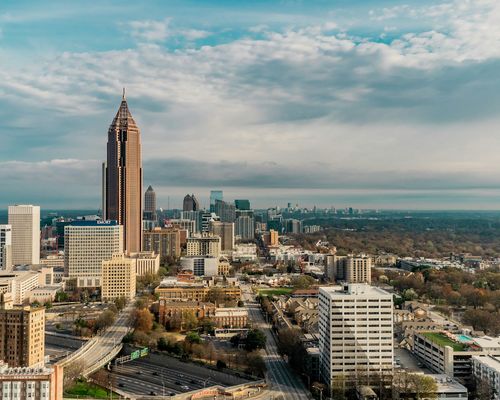
One of Atlanta’s most ambitious plans to transform an aging office building into new housing has been abandoned, offering a significant warning about the challenges facing office-to-residential conversions across the city. Georgia-Pacific has ended plans to convert portions of its iconic 51-story Georgia-Pacific Center in Downtown Atlanta into apartments, citing rising construction costs and broader market conditions.
The decision is particularly notable because the project was designed to be much more than a residential conversion. Announced in 2024, the redevelopment called for about 400 apartments on the upper floors of the 697-foot tower, along with retail, restaurants and entertainment space at street level. Earlier plans also included approximately 125,000 square feet of retail and entertainment space and a 35,000-square-foot central plaza intended to create more activity along Peachtree Street.
The project was envisioned as a major example of adaptive reuse at a time when Atlanta, like many major U.S. cities, has been looking for ways to repurpose underused office space. The Georgia-Pacific Center contains roughly 1.3 million square feet and has long been one of Downtown Atlanta's most recognizable office towers. The proposed redevelopment would have significantly changed the building's role by reducing its reliance on traditional office tenants while bringing hundreds of residents into the heart of Downtown.
For real estate professionals, however, the cancellation illustrates one of the biggest obstacles to office conversions: the economics do not always work, even when there is strong demand for housing. Converting an existing office tower into apartments can require major changes to plumbing, electrical systems, mechanical infrastructure, windows, elevators, floor layouts and other building systems. In this case, Georgia-Pacific said higher construction costs and broader market headwinds changed the economic viability of the project at its planned scale.
That distinction is important for Atlanta's real estate market. A shortage of housing does not automatically make every vacant or underused office building suitable for conversion. The cost of adapting a building, the configuration of its floor plates, access to natural light, existing infrastructure, financing conditions and expected apartment rents all play a role in determining whether a conversion can generate an acceptable return.
The timing also reflects the continued pressure on Atlanta's office market. According to the Atlanta Journal-Constitution, about 30% of the Atlanta area's office square footage was vacant or available for sublease at the end of the first half of 2026, underscoring the scale of the challenge facing office owners. At the same time, developers continue to face high construction and financing costs, making large-scale adaptive-reuse projects more difficult to justify.
The cancellation does not mean Georgia-Pacific is leaving Downtown Atlanta or abandoning the building. Instead, the company plans to focus on modernizing the existing office environment at Georgia-Pacific Center. That shift is significant because it suggests that, for some major office properties, repositioning the existing workspace may currently make more financial sense than attempting a wholesale conversion to residential use.
For Atlanta real estate professionals, the Georgia-Pacific decision is a reminder that the city's office transformation will likely be selective rather than universal. Some buildings may be strong candidates for residential conversion, while others may be better positioned for renovation, new amenities, mixed-use repositioning or continued office use. The future of Atlanta's office market may not be about converting every underused building into apartments, but about determining which properties can realistically support a new use.
The loss of the Georgia-Pacific residential project is also significant for Downtown Atlanta's housing pipeline. The planned 400 apartments would have added hundreds of potential residents to a central business district where developers and city officials have been working to increase residential activity. With those units no longer moving forward, other downtown residential developments will become even more important to the area's effort to create a stronger mix of housing, employment, retail and entertainment.
Ultimately, Georgia-Pacific's decision represents a major reality check for Atlanta's adaptive-reuse ambitions. Office-to-residential conversion remains an important strategy, but high construction costs, financing challenges and uncertain market conditions can quickly change the feasibility of even highly visible projects. For brokers, investors, developers and property owners, the lesson is clear: Atlanta's changing office market is creating opportunities, but identifying the right property—and making the numbers work—will be critical.

Discussion
Thoughts from readers and local market watchers.