



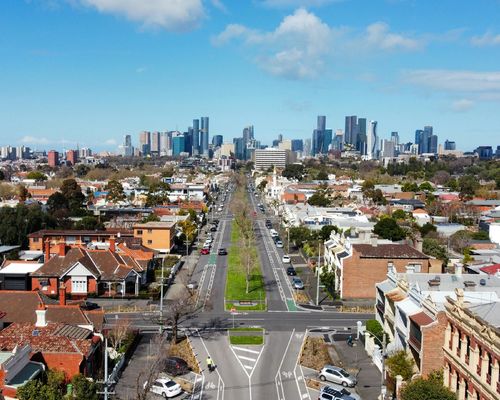
For years, Australia's housing market seemed almost unstoppable.
Even as affordability deteriorated, borrowing costs rose, and economists repeatedly warned that prices had become detached from household incomes, home values continued to climb. Buyers remained active, investors continued chasing returns, and a severe housing shortage helped support prices across much of the country.
That momentum is now beginning to fade.
New forecasts from property analysts suggest Australian home prices are on track to record their weakest annual growth in four years, marking a significant shift for a market that has been one of the strongest performers among developed economies over the past decade.
The slowdown is not being driven by a flood of new housing supply or a collapse in demand. Instead, it is the result of a growing financial squeeze facing households across the country. Higher mortgage rates, rising living costs, and growing uncertainty about the economic outlook are forcing many buyers to step back from the market.
The result is a housing sector that is no longer moving in one direction.
Higher Borrowing Costs Are Changing Buyer Behavior
The Reserve Bank of Australia spent much of the year fighting inflation, pushing interest rates higher in an effort to cool the economy. While inflation remains a concern, the side effects of those rate increases are becoming increasingly visible in housing.
Mortgage repayments have risen substantially for many households, reducing borrowing capacity and limiting how much buyers can afford to spend.
For first-time buyers, the challenge is even greater.
Many younger Australians were already struggling to save for deposits in a market where home values had significantly outpaced wage growth. Now they face the additional hurdle of higher financing costs, making homeownership feel even further out of reach.
As a result, buyer demand has softened, particularly in markets where prices had already reached extreme levels.
The Affordability Problem Has Not Gone Away
One of the most important aspects of the current slowdown is that it does not solve Australia's affordability crisis.
Price growth may be cooling, but housing remains extraordinarily expensive relative to incomes.
In many parts of the country, buyers continue to face home values that are multiple times higher than average household earnings. Slower growth does little to help affordability when prices are already near record highs.
This creates an unusual market dynamic.
Homeowners are seeing smaller gains than they enjoyed in recent years, while prospective buyers are still struggling to enter the market. Neither side is experiencing significant relief.
For policymakers, this highlights a reality that has become increasingly difficult to ignore: slowing price growth alone will not fix Australia's housing challenges.
Sydney and Melbourne Are Feeling the Pressure
The largest signs of weakness are emerging in Australia's biggest property markets.
Sydney and Melbourne, which have traditionally attracted the largest share of investor activity and experienced some of the strongest price appreciation over the years, are now facing downward pressure.
These cities tend to be the most sensitive to interest rate changes because buyers often carry larger mortgage balances and higher debt loads.
As financing becomes more expensive, demand naturally weakens.
Property professionals are already reporting softer auction results, longer selling periods, and more cautious buyer behavior compared with the frenzied conditions seen during the pandemic-era housing boom.
The shift does not necessarily signal a market crash, but it does represent a meaningful change from the aggressive competition that characterized recent years.
Not Every Market Is Slowing
While Sydney and Melbourne are cooling, other cities continue to perform relatively well.
Brisbane, Perth, and Adelaide have benefited from stronger population growth, comparatively better affordability, and lower starting price points.
These markets continue attracting buyers who have been priced out of Australia's most expensive cities.
Migration patterns are also playing a role.
Remote and hybrid work arrangements have encouraged some Australians to relocate to more affordable regions, supporting demand outside traditional housing hotspots.
This divergence means Australia no longer has a single housing market. Instead, it has a collection of local markets moving at different speeds and responding to different economic pressures.
Investors Are Watching Tax Changes Closely
Adding another layer of uncertainty is the government's proposed overhaul of property investment tax incentives.
For decades, many Australian investors relied on favorable tax treatment to justify purchasing rental properties. Proposed changes to those incentives have sparked debate throughout the real estate industry.
Supporters argue the reforms could make housing more accessible for owner-occupiers by reducing investor competition.
Critics warn that discouraging investment could reduce rental housing supply at a time when vacancy rates remain historically low.
The concern is particularly relevant because rental markets across much of Australia are already under pressure.
Even as home price growth slows, rents continue to rise.
For many households unable to purchase a home, renting is becoming increasingly expensive, creating another affordability challenge that policymakers must address.
A Market Transition Rather Than a Collapse
Despite the growing headwinds, most analysts are not predicting a severe housing downturn.
Australia continues to face a long-term shortage of housing, population growth remains supportive, and unemployment levels remain relatively low by historical standards.
Those factors should provide a floor under prices even as demand softens.
Instead, what appears to be unfolding is a transition away from the extraordinary growth rates that defined the post-pandemic housing cycle.
The era of rapid double-digit gains is giving way to a slower, more selective market where affordability, interest rates, and local supply conditions matter more than ever.
For buyers, that could mean greater negotiating power and less competition.
For sellers, it means expectations may need to adjust.
And for policymakers, it serves as another reminder that Australia's housing affordability crisis cannot be solved through market cycles alone. The deeper challenge remains the same as it was before prices started cooling: there simply are not enough homes being built to meet long-term demand.
As 2026 unfolds, that fundamental imbalance may prove to be the most important real estate story of all.
Discussion
Thoughts from readers and local market watchers.