



For millions of American homeowners, moving into a different house could mean taking on a mortgage payment hundreds or even thousands of dollars higher than what they currently pay. A new Realtor.com analysis shows just how much higher home prices and mortgage rates have raised the cost of buying a home, creating another obstacle for an already struggling housing market.
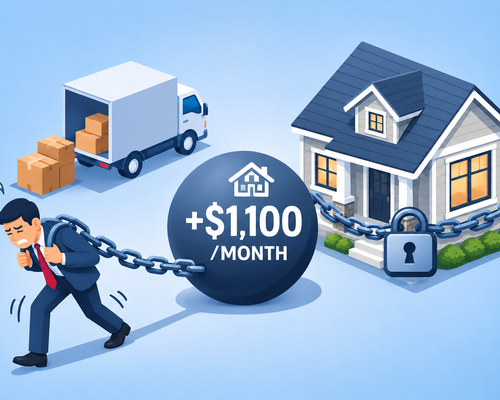
According to the November 11 report, the typical U.S. mortgage holder pays approximately $1,332 per month in principal and interest. Buying a median-priced home today would push that estimated payment to $2,468, an increase of roughly $1,100 per month, or 85.3%.
The difference largely comes down to mortgage rates. The typical outstanding mortgage carries an interest rate of around 4%, while the report modeled a new purchase using a 7.32% rate.
New England Faces Some of the Biggest Payment Gaps
The impact is particularly pronounced in parts of New England.
Portland, Maine, ranked first nationally, with the estimated monthly mortgage payment rising from $1,270 for the typical existing mortgage holder to $3,392 for someone purchasing a median-priced home. That's a 167% increase.
Other regional markets are also facing substantial differences. In Bridgeport, Connecticut, the estimated payment gap reaches 138.4%, while Providence, Rhode Island, and Massachusetts, records a 137.1% increase. Worcester, Massachusetts, follows with a 128.7% gap.
These figures help explain why many homeowners are reluctant to sell. Even when they want a larger home, a different location, or a change in lifestyle, the financial cost of giving up an older mortgage can make moving difficult.
Why This Matters for Housing Inventory
The mortgage rate lock-in effect has become one of the biggest obstacles to normal housing market activity. Homeowners with lower interest rates have a financial incentive to stay put, reducing the number of properties entering the market.
That creates a ripple effect. Fewer homeowners selling means fewer available homes for buyers, while limited supply can keep prices elevated even as affordability deteriorates.
Realtor.com estimates that mortgage rates would need to fall to approximately 6% for just over half of U.S. households to afford a median-priced home. Even at that level, the typical payment would remain more than 60% higher than what existing mortgage holders currently pay.
The housing market's affordability problem is not just about getting mortgage rates lower. Home prices and household incomes also need to move into better balance.
For real estate professionals, the findings highlight why homeowners may be hesitant to list their properties, even when they have built substantial equity. Until the financial gap between keeping an existing home and purchasing another one narrows, the market could continue experiencing limited inventory and weaker transaction activity.
The challenge is becoming increasingly clear: many homeowners can afford the house they already own, but cannot comfortably afford to move.
Discussion
Thoughts from readers and local market watchers.