



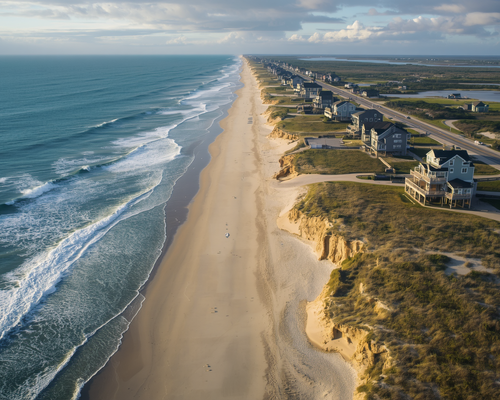
North Carolina's coastline has long been one of the state's most desirable real estate markets, attracting vacationers, retirees, second-home buyers, and investors seeking a slice of waterfront living. But this week, another dramatic reminder emerged that owning property along the coast comes with growing risks.
An oceanfront home in Buxton on the Outer Banks collapsed into the Atlantic Ocean, becoming the latest casualty in a troubling trend that has increasingly captured the attention of homeowners, developers, insurers, and real estate professionals alike. The collapse adds to a growing list of coastal properties lost to erosion, storm damage, and shifting shorelines over the past several years.
According to reports, more than 30 homes have been destroyed along portions of North Carolina's coastline since 2020. While each collapse attracts headlines, industry experts say these incidents represent a much larger issue that is beginning to reshape how coastal real estate is bought, sold, financed, and insured.
A Growing Challenge Along the Outer Banks
The Outer Banks have always existed in a delicate balance with nature. The barrier islands are constantly changing as waves, tides, storms, and wind reshape the coastline. Historically, erosion has been a reality for waterfront property owners, but recent years have intensified concerns.
Repeated hurricanes, nor'easters, rising sea levels, and stronger storm surges have accelerated shoreline changes in several coastal communities. Homes that once sat comfortably behind protective dunes now find themselves dangerously close to the ocean.
In some cases, properties built decades ago were constructed much farther from the water than they appear today. As beaches narrow and shorelines retreat, structures become increasingly vulnerable to collapse.
The recent Buxton incident serves as another reminder that coastal erosion is no longer a theoretical concern. It is a reality that many property owners are confronting firsthand.
Environmental Risk Is Becoming a Major Real Estate Factor
The collapse is also highlighting a broader shift taking place throughout the real estate industry.
For years, buyers often focused primarily on location, amenities, views, and investment potential when evaluating waterfront properties. Today, environmental risk is becoming an increasingly important part of the equation.
Questions that once received little attention are now becoming standard parts of the buying process.
How vulnerable is the property to flooding?
What are the long-term erosion trends in the area?
How much will flood and wind insurance cost?
Are there projected changes to shoreline stability over the next decade?
Could future storms significantly alter the property's value or insurability?
These considerations are no longer limited to high-risk investors or institutional buyers. Everyday homebuyers are increasingly asking the same questions before making purchasing decisions.
Insurance Costs Continue to Rise
One of the most immediate impacts of growing coastal risk is the effect on insurance.
Homeowners along the North Carolina coast have already experienced rising premiums in recent years as insurers reassess exposure to flooding, hurricanes, and storm-related losses.
For some property owners, insurance costs have become one of the largest expenses associated with owning a coastal home. In certain cases, buyers are discovering that insurance affordability can influence purchasing decisions just as much as mortgage rates.
Lenders are also paying closer attention. Properties located in vulnerable coastal zones may face stricter underwriting requirements, higher insurance obligations, or additional inspections before financing is approved.
As environmental risks become more apparent, insurance is increasingly becoming a key factor in overall housing affordability.
Demand Remains Strong Despite the Risks
Despite these challenges, demand for North Carolina coastal real estate remains remarkably resilient.
The Outer Banks, Wilmington region, Crystal Coast, and other waterfront destinations continue attracting buyers from across the country. Vacation rentals remain popular, second-home demand remains active, and many retirees still view coastal North Carolina as an attractive destination.
The appeal is easy to understand. Waterfront views, beach access, recreational opportunities, and a unique coastal lifestyle continue to drive strong interest in these markets.
However, today's buyers are often approaching these purchases with a greater emphasis on due diligence. Understanding flood maps, erosion histories, insurance requirements, and long-term environmental conditions has become a more important part of the decision-making process.
How Coastal Communities Are Responding
Local governments and coastal communities are also grappling with how best to respond.
Some areas have explored beach nourishment projects, dune restoration efforts, and infrastructure improvements designed to help protect vulnerable sections of shoreline. Others are reassessing development practices and considering how future growth should be managed in areas facing increasing environmental pressure.
The challenge is balancing economic growth and property rights with long-term sustainability.
For communities that rely heavily on tourism and real estate investment, these decisions carry significant economic consequences.
What This Means for Real Estate Professionals
For real estate agents, investors, lenders, and developers, coastal risk is becoming an increasingly important part of market analysis.
Understanding environmental conditions, insurance trends, and local regulations is no longer optional in many coastal markets. Buyers are seeking more information than ever before, and professionals who can provide guidance on these issues are becoming valuable resources.
The market is not retreating from the coast, but it is evolving.
Environmental resilience, risk assessment, and long-term planning are becoming more closely tied to property valuation and investment decisions.

Discussion
Thoughts from readers and local market watchers.