



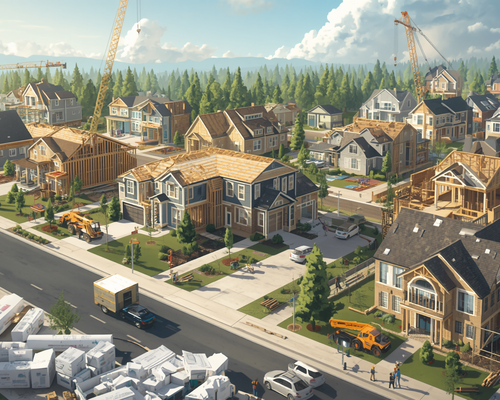
Despite elevated mortgage rates, affordability challenges, and growing concerns about the direction of the housing market, new government data shows that construction activity across the United States continues to display unexpected resilience.
According to the latest figures released by the U.S. Commerce Department's Census Bureau, total construction spending rose 0.4% in April, outperforming economists' expectations and signaling that builders have not completely backed away from new projects despite mounting economic headwinds. The increase followed a revised 0.2% gain in March and pushed overall construction spending 0.9% higher than a year earlier.
The report arrives at a particularly important moment for the housing market. Over the past several months, rising mortgage rates, persistent inflation concerns, and growing uncertainty tied to global events have raised fears that residential construction activity could slow significantly. Instead, the latest numbers suggest builders are still finding opportunities in a market that remains undersupplied, even as buyers face increasing affordability challenges.
Much of April's growth came from the residential sector, which continues to serve as one of the most important drivers of construction activity nationwide. Residential construction spending increased 0.8% during the month, while spending on new single-family housing projects jumped 1.4%. These gains indicate that builders are still actively investing in new homes despite a cooling sales environment and rising borrowing costs.
The strength in single-family construction is particularly noteworthy because it comes at a time when many housing indicators have been sending mixed signals. New-home sales recently declined, mortgage applications have weakened, and homebuilder confidence remains below historical norms. Yet builders continue moving forward with projects, reflecting both the ongoing shortage of housing and expectations that demand will remain present over the long term.
Industry analysts say the housing market is currently experiencing a unique balancing act. On one side, affordability remains one of the biggest obstacles facing prospective homebuyers. On the other, years of underbuilding have left many communities with insufficient housing inventory, creating a need for continued construction even as financing conditions become more difficult.
Mortgage rates remain a central concern. The average 30-year fixed mortgage rate recently climbed to approximately 6.53%, reaching its highest level in about nine months. Since the beginning of the Iran conflict earlier this year, bond markets have reacted to inflation concerns and rising energy prices, pushing borrowing costs higher throughout the economy. Higher mortgage rates reduce purchasing power, making it more difficult for households to qualify for loans and increasing monthly payments for new buyers.
Builders are increasingly feeling the effects of those higher rates. While construction spending remains positive, many developers report that elevated financing costs are making it more difficult to launch new projects. Buyers are becoming more selective, sales cycles are lengthening, and incentives such as mortgage-rate buydowns and closing-cost assistance have become increasingly common throughout many markets.
Beyond financing costs, builders are also facing rising expenses related to labor, land, and materials. Recent tariff changes affecting imported steel, aluminum, and copper have added another layer of uncertainty to future construction budgets. While the full impact of those policy changes remains unclear, many industry observers expect material costs to remain elevated throughout the remainder of the year.
Not every segment of construction shared in April's growth. Spending on multifamily housing projects declined 0.3%, reflecting ongoing adjustments in the apartment sector after several years of aggressive development. Meanwhile, private nonresidential construction—including projects such as factories, offices, and power facilities—fell 0.2%. In fact, nonresidential construction has now contracted for nine consecutive quarters, highlighting broader challenges facing parts of the commercial real estate market.
One area that continued to expand was public construction. Government-funded projects increased 0.4% during April, supported by both state and federal spending. Federal construction outlays rose nearly 4.8%, contributing significantly to overall construction growth and helping offset weakness in some private-sector categories.
The latest report paints a picture of a construction industry that remains active but increasingly divided. Residential builders continue trying to meet long-term housing demand, while commercial developers face a more uncertain outlook. Government projects are providing additional support, but private investment remains under pressure from high borrowing costs and economic uncertainty.
For housing professionals, the most important takeaway may be that construction activity is proving more resilient than many analysts expected. While housing affordability remains a serious challenge and mortgage rates continue to weigh on demand, builders have not abandoned new development efforts.
That resilience could prove critical in the years ahead. The United States continues to face a substantial housing shortage, and economists widely agree that increasing supply remains one of the most effective ways to improve affordability over the long term. Even if home sales fluctuate and borrowing costs remain elevated, sustained construction activity will be necessary to address the structural imbalance between housing supply and demand.
The months ahead will reveal whether builders can maintain this momentum. Rising mortgage rates, material costs, and economic uncertainty continue to create risks for the industry. But for now, the latest data suggests that construction activity remains one of the brighter spots within an otherwise challenging housing market.
As summer begins, builders appear committed to pushing forward—even as affordability pressures, inflation concerns, and financial market volatility continue shaping the future of U.S. real estate.

Discussion
Thoughts from readers and local market watchers.