



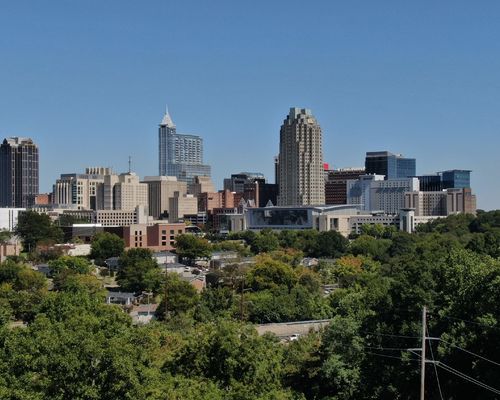
A major redevelopment is underway along Glenwood Avenue in Raleigh, where an aging portion of Pleasant Valley Promenade is being demolished to make way for new retail and a large apartment community.
The redevelopment will bring a new Sprouts Farmers Market to the shopping center, while plans for the adjacent Promenade Park call for approximately 351 multifamily apartments. Construction activity is already visible at the longtime shopping center, marking a significant transformation of a property that has served Raleigh for decades.
The apartment project was approved by the City of Raleigh as a 351-unit, five-story multifamily development on approximately 6.3 acres. Plans call for 205 one-bedroom, 133 two-bedroom and 13 three-bedroom apartments, along with a large parking deck.
The residential development is being integrated into the existing retail center rather than built as a stand-alone neighborhood. That approach reflects a growing trend across North Carolina, where developers are increasingly combining housing, grocery stores, restaurants and retail to create communities where residents can live closer to everyday services.
The new Sprouts location is expected to open in 2027, adding another major grocery option to the Glenwood Avenue corridor. Existing retailers at Pleasant Valley Promenade include Marshalls, Ross, Petco, Ulta, Boot Barn and other national and local businesses.
The location is particularly significant because of its access to major employment centers. Pleasant Valley Promenade sits along a heavily traveled section of Glenwood Avenue, with direct connections toward Downtown Raleigh, North Hills, Research Triangle Park and Durham. The property currently sees approximately 37,000 vehicles per day, according to the property's leasing information.
For Raleigh's housing market, adding 351 new apartments to an established retail corridor could have an impact beyond the project itself. New residents bring additional demand for restaurants, services and nearby housing, while improved retail offerings can make surrounding neighborhoods more attractive to renters and buyers.
The redevelopment also demonstrates how the Triangle's limited land supply is encouraging developers to rethink properties that were previously used primarily for shopping. Instead of expanding farther into undeveloped areas, projects like Pleasant Valley Promenade are adding housing to already established commercial corridors.
That shift is becoming increasingly important as Raleigh continues to grow. The city needs additional housing, but land, construction and infrastructure costs remain high. Redeveloping existing commercial properties can provide another way to add residential units without creating an entirely new suburban development.
The Pleasant Valley project therefore represents more than a new apartment complex and grocery store. It is another example of how Raleigh's older commercial properties are being reshaped to accommodate a growing population, while creating denser, more connected areas where housing and everyday amenities are located together.
With construction now underway, the transformation of Pleasant Valley Promenade is expected to become increasingly visible over the coming year, adding another major residential and retail development to one of Raleigh's busiest growth corridors.

Discussion
Thoughts from readers and local market watchers.