



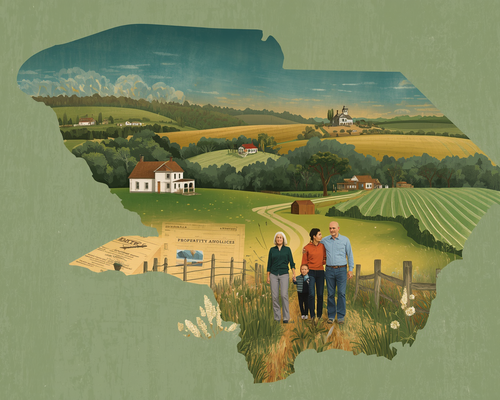
A significant property-rights reform has officially become law in South Carolina, offering new protections for families who have inherited land across generations and helping address one of the most persistent causes of land loss throughout the state.
Governor Henry McMaster signed H.4477, the Heirs' Property Tax Relief Act, into law on May 15, 2026. The legislation passed unanimously through both chambers of the General Assembly and took effect immediately upon the governor's approval.
For many South Carolinians, especially families in the Lowcountry, the law represents much more than a tax change. Supporters view it as a long-awaited step toward preserving family land, protecting generational wealth, and reducing one of the major barriers that has historically prevented heirs from formally securing ownership of inherited property.
What Is Heirs' Property?
Heirs' property is land that has been passed down from generation to generation without a clear probate process, formal will, or properly recorded deed transfer.
Over time, ownership becomes divided among numerous descendants, often spread across multiple states and generations. While family members may continue living on or maintaining the property, legal ownership can become fragmented and difficult to establish.
In many cases, dozens of individuals may technically own a share of a single parcel of land. Some heirs may not even realize they have an ownership interest. Others may be difficult to locate altogether. This creates what attorneys often call a "tangled title," making it challenging to sell, finance, improve, or protect the property.
The problem is particularly widespread in South Carolina, where inherited family land has played an important role in rural communities, farming families, and the historic Gullah Geechee communities of the coastal region.
The Hidden Tax Problem Families Faced
Ironically, one of the biggest obstacles to fixing heirs' property issues has been the property tax system itself.
Before the new law, families who attempted to clear ownership titles often risked triggering what is known as an "assessable transfer of interest." Once that occurred, local governments could reassess the property based on current market value.
For families whose land had been held for decades, especially in rapidly appreciating areas such as Hilton Head Island, Beaufort County, Charleston County, and other coastal communities, that reassessment could lead to substantially higher property taxes.
As a result, many families found themselves trapped.
They knew the title needed to be cleared. They understood the legal risks associated with tangled ownership. Yet formally resolving those issues could create a tax burden that some families simply could not afford.
The new law directly addresses that problem.
What H.4477 Changes
The Heirs' Property Tax Relief Act amends South Carolina's property tax code to exclude certain family transfers made for the purpose of clearing title from being treated as assessable transfers.
In practical terms, qualified family members can now work to consolidate ownership and clear title without automatically triggering a property tax reassessment solely because of that transfer.
The legislation applies when ownership interests are transferred among qualified family members who already possess a legal claim to the property and are taking action specifically to resolve heirs' property ownership issues. Once title has been successfully cleared, the property is no longer considered heirs' property and the special exemption no longer applies.
The law applies to property tax years beginning after 2025.
Why This Matters in the Lowcountry
Few regions have been affected by heirs' property challenges more than South Carolina's coastal communities.
For decades, Gullah Geechee families have faced increasing pressure from rising land values, luxury development, tourism growth, and escalating property taxes. Many families inherited land from relatives who acquired property generations ago, often shortly after emancipation, creating deep cultural and historical connections to the land.
As development accelerated across Hilton Head Island, Beaufort County, and surrounding areas, property values rose dramatically.
In some cases, families found themselves owning land worth millions of dollars on paper while lacking the resources needed to navigate complicated title issues or absorb higher tax bills. The inability to clear title often made families vulnerable to tax sales, legal disputes, and unwanted development pressure.
Advocates have long argued that many families were losing ancestral land not because they wanted to sell it, but because the legal and financial barriers to preserving ownership had become overwhelming.
The new legislation seeks to remove at least one of those barriers.
Years of Advocacy Led to the Law
The passage of H.4477 did not happen overnight.
The legislation emerged from years of work by organizations including the Lowcountry Gullah Foundation, the Center for Heirs' Property Preservation, housing advocates, attorneys, local officials, and community leaders. These groups spent years educating lawmakers about the unique challenges associated with heirs' property ownership and the unintended tax consequences families faced when attempting to resolve title issues.
Advocates argued that if policymakers wanted families to establish clear ownership, the system should not punish them for doing so.
That message ultimately gained bipartisan support in Columbia, helping the bill move through the legislature without opposition.
What It Means for Real Estate Professionals
For REALTORS®, attorneys, title professionals, estate planners, and land-use experts, the new law could have far-reaching implications.
Clear ownership is one of the most important foundations of any real estate transaction. When title issues remain unresolved, families often struggle to:
- obtain financing
- transfer ownership
- qualify for assistance programs
- improve or develop property
- create estate plans
- preserve generational wealth
By making it easier to clear title without triggering immediate tax consequences, the law may encourage more families to formally address ownership issues that have remained unresolved for decades.
Over time, that could lead to stronger property rights, improved marketability of inherited land, and greater stability for families seeking to preserve property across generations.
A Major Step, But Not the Final Solution
While advocates are celebrating the passage of the Heirs' Property Tax Relief Act, many acknowledge that additional work remains.
Title-clearing costs, probate challenges, family disputes, estate planning gaps, and rising development pressure continue to affect inherited properties throughout South Carolina. Advocates are already discussing additional reforms that could further protect heirs' property owners and reduce the risk of involuntary land loss.
Still, supporters believe H.4477 marks one of the most meaningful property-rights victories in recent years.
For thousands of South Carolina families, particularly those who have spent generations caring for inherited land, the law creates a clearer and more affordable path toward securing ownership, preserving family heritage, and protecting land that might otherwise have been lost forever.

Discussion
Thoughts from readers and local market watchers.